Cultivated meat’s costs and climate impact depend on energy use across the whole process - not just the bioreactor. I’d start by checking electricity and heat per kilogram of saleable product, then asking where that energy comes from.
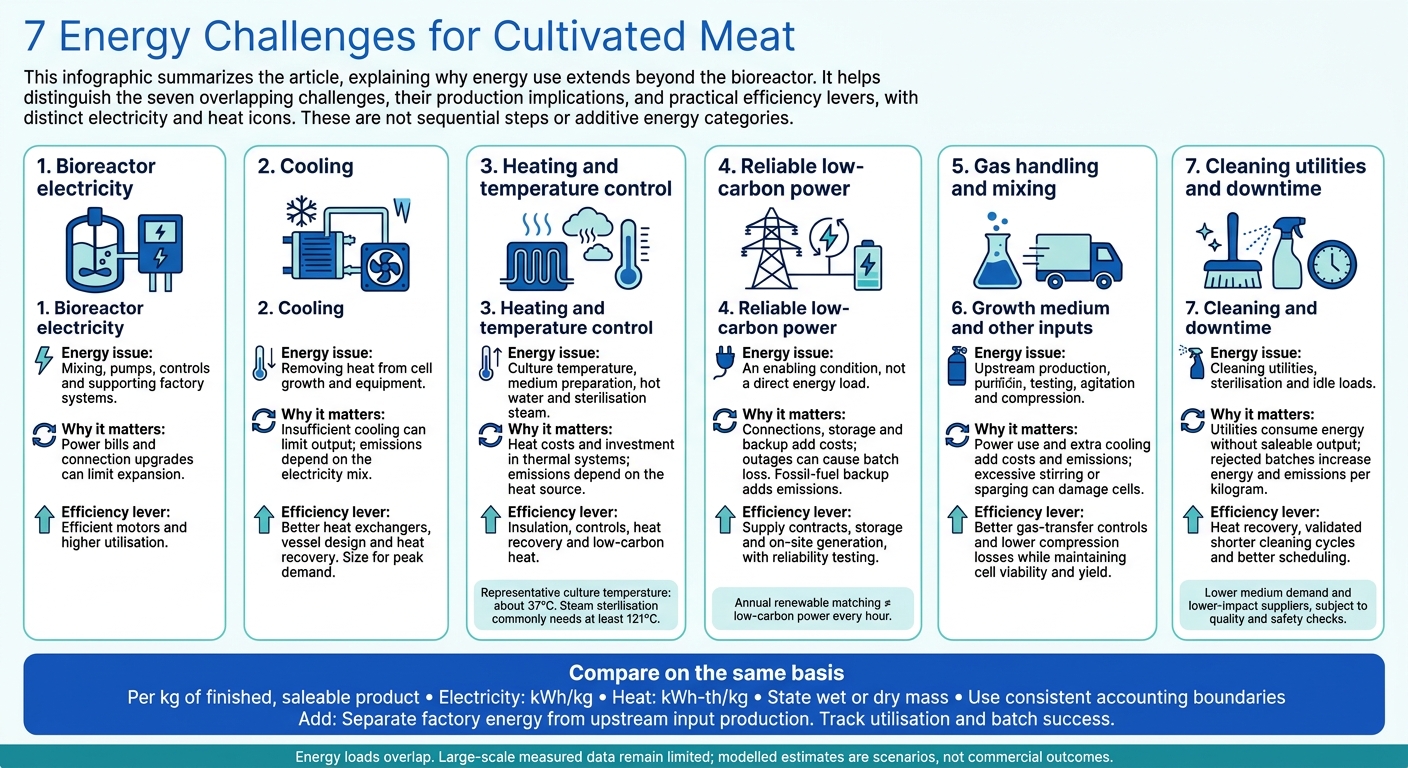
The seven challenges are:
- Bioreactor electricity: powering mixing, pumps and monitoring bioreactor metrics.
- Cooling: removing heat without slowing cell growth.
- Heating: supplying heat for cultures, medium preparation and steam.
- Reliable low-carbon power: keeping production running through supply gaps.
- Gas handling: delivering oxygen and removing carbon dioxide.
- Input production: accounting for energy used to make medium ingredients.
- Cleaning and downtime: using utilities even when no saleable meat is produced.
One model put electricity at about 35% of production costs in its best-case scenario - not an industry average.[12] I treat such figures as estimates: <u>large-scale measured data remain limited</u>. Lower energy use, fewer failed batches and cleaner power can help, but none alone guarantees lower prices or a UK launch date.
7 Energy Challenges for Cultivated Meat
Using innovative engineering solutions to solve cultivated meat’s biggest challenges - CMS22
sbb-itb-c323ed3
Measuring Energy Use per Kilogram of Cultivated Meat
Measure energy use per kilogram of finished, saleable Cultivated Meat, not harvested cell slurry. Count output after washing, structuring, formulation and quality checks. State whether you use wet or dry mass: water content can make the process appear more or less efficient. Set the boundary, too. Does it cover factory activities only, or cradle-to-gate, including the manufacture and supply of inputs? The same process can look efficient or inefficient depending on what you count.[7][11]
With that boundary set, report electricity in kWh/kg and heat in kWh-th/kg separately. Electricity powers cooling, pumps, mixing and ventilation. Heat supports medium preparation, hot water and sterilisation. Keep factory energy separate from the energy used to produce and supply inputs. For conversions, 1 kWh = 3.6 MJ.[5][8]
Industrial facilities have energy demands that laboratory results leave out. These include starter-stage activities, large-scale cooling, harvesting, wastewater treatment and cleaning. They also offer scope for heat recovery and more efficient equipment use. Report annual output in tonnes per year, the utilisation rate and temperature-control assumptions in °C, rather than reactor size alone.[8][10]
When reading an estimate, check its output basis, energy boundary, electricity mix and heat source, and whether the results are measured or modelled. Modelled estimates are scenarios, not commercial outcomes. Higher kWh/kg increases production costs, but does not, on its own, predict the retail price.[5][8]
1. Electricity Demand from Large Bioreactors
With the measurement boundary set, the first major electricity load comes from equipment that keeps cells mixed, supplied and controlled. As production grows, this demand puts pressure on costs, emissions and rollout.
Different bioreactor designs use electricity for agitation, pumping, gas transfer and controls. Agitators mix cells and nutrients, pumps move medium, and compressors supply gases. Sensors and controls monitor pH, oxygen, temperature and pressure, while heat exchangers regulate temperature. Filtration, harvesting, water treatment, centrifuges and ventilation add to the load.[10]
CE Delft’s 2022 model estimated annual electricity demand at approximately 217 million kWh, including these other factory systems. This was a modelled requirement, not a measured commercial result.[10]
Bigger vessels don’t automatically use less electricity per kilogram. The goal is efficient production of saleable output, not just lower motor power. Larger vessels can reduce the number of vessels, pumps and other components needed, but they also make mixing and oxygen delivery harder. Faster stirring uses more motor power and can damage sensitive cells. Higher cell densities increase output, but also increase oxygen demand and heat generation.[12]
Electricity demand adds to both costs and emissions. One assessment put electricity at approximately 35% of cost of goods sold in its best-case scenario - not a figure that applies to every facility.[12] Low-carbon power can cut emissions from running the facility, but it doesn’t reduce the equipment’s electricity use.[14]
Adding production lines therefore takes more than extra vessels. Developers should measure peak loads and check grid capacity, transformers, switchgear and backup power before expanding. Limited local capacity or the need for grid upgrades could delay rollout, even when production equipment is ready.[10]
That electricity load also produces waste heat, bringing another challenge: cooling.
2. Cooling Large Culture Vessels
Heat from mixing, gas transfer and cell growth becomes harder to remove as vessels get larger. Surface area grows more slowly than volume, so a cooling jacket alone may not prevent hot spots. Heat removal can limit output, not just increase energy use.[1][12]
Heat exchangers transfer heat from the culture or jacket fluid to a separate coolant. That coolant then passes through a chiller, cooling tower or air cooler. The system must stay sterile and protect cells from shear damage, which limits how fast it can remove heat.[1][12]
Cooling brings equipment, maintenance and electricity costs. Too little capacity can force production to slow down, increasing the cost per kilogram and limiting supply. Lower-carbon electricity cuts emissions, but the heat still needs somewhere to go.[1][12]
Size cooling for peak demand, not average demand. Multi-point sensors, variable-speed pumps and flow controls can help prevent hot spots without overcooling. Operators should check these settings against cell viability, batch yield and electricity use per kilogram.[1][12]
Passive cooling may help when weather and water temperatures permit, but warm weather can still make active backup necessary. Recovered heat could pre-heat cleaning water or heat buildings, provided the temperatures and demand match.[12][15] The plant must also keep the culture at a stable temperature. This is one of many cultivated meat challenges and solutions that engineers must address during scale-up.
3. Heating and Temperature Control
After cooling, heat for growth, cleaning and sterilisation is the next energy load. Cultivated Meat facilities use heat to prepare medium, maintain culture temperatures, a critical part of how cultivated meat is made, clean equipment in place and sterilise it with steam. A representative process keeps cultures at about 37°C, while steam sterilisation commonly needs at least 121°C. These two temperature ranges mean a facility may need both low-grade and high-grade heat systems.[14][16]
Match the heat source to the temperature needed. Heat pumps suit low-temperature water and medium preparation; electric boilers can supply sterilisation steam. Both reduce on-site combustion, but their emissions still depend on the electricity mix. Grid upgrades and peak electricity demand also affect costs.[17][18]
Waste-heat recovery can reduce the heating load further. Recovered heat can preheat incoming medium, giving the primary heater less work to do. First, measure source temperatures and flow rates, then check that heat is available when needed. Heat exchangers must maintain sterile boundaries: energy savings must not weaken contamination control.[14][18]
Combined heat-and-power (CHP) suits facilities with steady demand for heat and electricity at the same time. Gas-fired CHP is not automatically low-emission. Compare its fuel use, emissions, maintenance needs and exposure to fuel prices against grid electricity plus electrified heat - not efficiency alone.[19]
Heating systems also add capital costs and can delay rollout. Boilers, steam lines, controls and backup capacity must meet peak demand. Before commercial production begins, start-up validation must confirm that sterilisation reaches the required temperature for the required time.[16][20]
4. Reliable Low-Carbon Electricity Supply
Once cooling, pumps and controls are running, electricity supply quality matters. An interruption can put Cultivated Meat batches at risk. Annual renewable contracts do not guarantee low-carbon power every hour: certificates may match yearly use but still leave gaps in hourly carbon coverage. Hourly matching, often called 24/7 low-carbon electricity, makes this distinction clearer.[21][22]
Check that the site can secure a firm, round-the-clock supply and a connection date that supports continuous operation. Supply gaps can delay launch, cause batch losses and limit expansion.
Batteries can cover short interruptions and reduce peak imports, but they cannot cover prolonged winter shortfalls. Plan for firm grid supply and longer-duration backup.[23] Backup planning is therefore a cost issue as well as a carbon issue. This is critical for maintaining the environmental benefits of the production process.
Compare delivered cost, not just the tariff. Include connection charges, storage losses, backup equipment and backup fuel when assessing costs and emissions calculations. Emissions calculations must also account for backup fuel use and runtime: fossil-fuel generators still add emissions, even when annual renewable purchases match the facility’s electricity consumption.
5. Airflow, Agitation and Gas Compression
After temperature control, gas transfer becomes the next scale-up constraint. Cultivated Meat cultures need oxygen delivered and carbon dioxide removed throughout the vessel. Larger vessels have less surface area relative to their volume, making gas exchange less efficient for the number of cells consuming oxygen and producing carbon dioxide.[16] Gas exchange does not scale linearly: mixing times can increase, requiring changes to sparging, agitation, gas-flow and control systems.[26] These challenges can limit throughput.
Oxygen-transfer rate must at least match the cells’ oxygen-uptake rate.
One model set oxygen transfer at 12.8 mmol O₂/L/h versus uptake of about 10.3 mmol at 100 g fresh weight/L; this is a model assumption, not a commercial benchmark.[6]
Faster stirring and more sparging - bubbling gas through the culture - can improve transfer. But both use more electricity and may damage sensitive cells.[24][25] Oxygen-enriched gas can increase oxygen concentration without increasing air volume, though it still adds energy use.[27] Antifoam can reduce oxygen transfer, so test its dose alongside sparger design, gas flow and bubble behaviour.[24]
Include stirrer motors, compressors and oxygen-enrichment systems when calculating total electricity demand.
Their energy share varies: one facility model found aeration and agitation each below 5% of total facility energy, with heat exchangers dominating.[9]
Test the lowest agitation and gas flow that still meet oxygen, carbon dioxide and mixing targets at scale. Track compressor electricity, cell viability, yield and batch duration together. Measure savings in kWh per kilogram of saleable Cultivated Meat. Lower power settings can backfire if they slow batches or cut yield, increasing cost and emissions per kilogram.[16][24][9] Gas handling is only part of the energy picture; input production adds another major load.
6. Energy Used to Make Growth Medium and Other Inputs
Medium ingredients carry energy costs before they reach the plant. Making glucose, amino acids, vitamins, minerals and recombinant proteins - such as insulin, transferrin and growth factors - requires crop processing, fermentation or chemical production. Separation, purification, quality testing and cold-chain storage add to this energy demand, increasing costs and emissions per kilogram of saleable Cultivated Meat.
One cradle-to-gate life-cycle assessment found that amino acids, glucose, recombinant proteins and soy hydrolysate accounted for large shares of the medium’s footprint in some energy scenarios.[13] These are modelled emissions shares, not measured energy shares or universal commercial averages.
Supplier location matters, but nearby does not automatically mean lower-carbon. Ask about electricity sources, process heat, purification and storage rather than using ingredient prices to judge energy demand. Include transport between feedstock suppliers, ingredient manufacturers and the facility, as refrigerated freight uses additional energy.[13]
Producers can reduce medium demand by lowering nutrient concentrations, using growth factors that work at lower doses and remain stable for longer, and reusing medium where growth and safety allow. Medium reuse remains experimental. It needs checks for growth, sterility, contamination, food safety, regulatory compliance and product quality.
Track litres of medium and ingredient mass per kilogram of saleable product, alongside supplier energy data, shelf life and rejected batches. More efficient formulations could ease costs and supply constraints, but savings depend on maintaining yield and securing reliable supplies. Limited capacity for specialised ingredients can restrict output and slow scale-up.[28]
7. Cleaning, Sterilisation and Downtime
Even efficient inputs leave the plant with cleaning work: cleaning and sterilisation consume energy without producing saleable Cultivated Meat. Clean-in-place (CIP) uses pumps, treated water and heated detergents. Sterilisation-in-place (SIP) uses steam and high temperatures. Energy demand depends on vessel size, cleaning temperature, cycle length, insulation and steam efficiency.[16]
Heating, ventilation and air conditioning (HVAC) may keep running during cleaning, maintenance and start-up. Water treatment, pumping and wastewater treatment add to the load.[5][30] Record steam use, treated-water volumes and HVAC running hours to track these demands.
Contaminated or rejected batches use energy twice: first during production, then through disposal, extra cleaning and start-up work. Fewer saleable kilograms mean higher energy costs and emissions per kilogram.[33] Track batch-success rate, rejected kilograms, start-up hours and extra cleaning cycles - not just total biomass grown. These measures help show the trade-off between utilisation, hygiene and energy intensity.
Higher utilisation and more successful harvests spread fixed utility loads over more output. Downtime does the opposite, increasing costs and emissions per kilogram. Shorten cleaning cycles only after validation. Recover condensate, improve insulation and schedule maintenance during planned changeovers. Effective cleanroom practices and reactor design significantly affect energy use.
| Factor | Batch | Continuous or semi-continuous |
|---|---|---|
| Energy drivers | Repeated heating, steam and pumping between runs.[16] | Fewer turnarounds, but continued pumping, filtration and monitoring loads.[16][31] |
| Utilisation | Cleaning and start-up reduce productive hours. | Longer runs spread fixed utility loads over more harvests.[31][33] |
| Process constraints | Validated cleaning is needed between runs.[16][29] | Longer uptime depends on stable cultures, reliable harvesting and contamination monitoring.[29][32] |
The 7 Energy Challenges Compared
The table below compares the seven challenges covered above. Their energy loads overlap, but each affects costs, emissions and the risks of scaling up differently. These factors are critical to the roadmap for cultivated meat as it moves toward commercialization.
| Energy challenge | Main load | Effect on production cost | Climate impact | Efficiency lever |
|---|---|---|---|---|
| 1. Electricity demand from large bioreactors | Reactor electricity | Power bills and connection upgrades can limit expansion. | Depends on demand and the electricity mix. | Efficient motors and higher utilisation. |
| 2. Cooling large culture vessels | Cooling | Adding cooling capacity costs money and can limit output. | Can be high on carbon-intensive grids. | Better heat exchangers, vessel design and heat recovery. |
| 3. Heating and temperature control | Process heat | Heat costs and investment in thermal systems. | Depends on the heat source. | Insulation, controls, heat recovery and low-carbon heat. |
| 4. Reliable low-carbon electricity supply | System reliability: an enabling condition, not a direct energy load. | Connections, storage and backup add costs; outages can cause batch loss. | Low-carbon supply cuts emissions; fossil-fuel backup adds them. | Supply contracts, storage and on-site generation, with reliability testing. |
| 5. Airflow, agitation and gas compression | Gas handling and mixing | Power use and cooling needs add costs. | Electricity use and extra cooling increase emissions. | Better gas-transfer controls and lower compression losses. |
| 6. Upstream energy for growth medium and inputs | Energy embodied in inputs | Energy-intensive inputs increase costs per kg. | Factory-only accounting misses supply-chain emissions. | Lower medium demand and lower-impact suppliers, subject to quality checks. |
| 7. Cleaning, sterilisation and downtime | Cleaning utilities and idle loads | Utilities keep running without saleable output. | Lower output increases emissions per kg. | Heat recovery, validated shorter cycles and better scheduling. |
For a like-for-like comparison, measure all seven per kg of output. Separate electricity, heat and fuel, and use the same accounting boundary and output measure throughout.
Conclusion: How Energy Affects Cost, Emissions and Availability
The seven energy challenges affect costs, emissions and the risks of scaling up.
Climate impact depends on the technology, ingredients, location and what the emissions calculation includes. Low-carbon electricity cuts one major source of emissions, but inputs, construction and transport still count.
Rollout depends on grid capacity, utility infrastructure, installation, commissioning and validation. Pilot success does not guarantee immediate availability, lower prices or a UK launch date.
For educational content, product previews and updates on availability, visit Cultivated Meat Shop, a curated educational resource and retail platform. No products are currently available to buy.
FAQs
How much could energy savings reduce Cultivated Meat prices?
Combined energy-saving measures, including AI-driven energy management and continuous processing instead of batch processing, are projected to help bring Cultivated Meat production costs below £10 per kilogramme by 2030.
Cooling and environmental controls can account for roughly 75% of a facility’s power use, so cutting that demand is key to keeping costs down. Renewable energy lowers the carbon footprint, but it only cuts production costs if the electricity itself is cheaper.
How can I assess Cultivated Meat’s climate claims?
Check the assumptions and methods behind life cycle assessments, as results can vary greatly [1]. Look at whether they cover the full production chain, including infrastructure and growth medium purification [2].
Renewable power can cut emissions by up to 92% compared with beef, while fossil fuels may lead to higher emissions [3][2]. The growth medium matters too: food-grade alternatives are needed to keep the environmental footprint below that of conventional farming [4].
Could UK grid constraints delay Cultivated Meat availability?
Yes. UK grid constraints could delay the rollout of Cultivated Meat. Production needs a large, reliable power supply to maintain temperatures at 37°C, sterilise equipment and run mechanical mixing.
The UK’s developing low-carbon energy infrastructure offers a route forward, but manufacturers still need steady access to renewable electricity. They’re focusing on sites near renewable energy hubs to help cut production’s long-term carbon footprint and align with national net-zero goals.