If you want the short answer: GOOD Meat has not gone straight to supermarkets. It has started with a small number of restaurants, then moved into limited retail and foodservice in Singapore, with access still tight because output is low and costs are high.
From what I can see, the pattern is simple:
- First came restaurant launches in Singapore, such as 1880 and Madame Fan
- Then came US restaurant service at China Chilcano in Washington, DC after 2023 approval
- Retail came later through Huber’s Butchery in Singapore in June 2024
- Home cooking access is still limited, and one retail item was a hybrid product with 3% cultivated chicken and 97% plant protein
- Price is still a barrier, with small-scale production put at about £50 to £100 per kg
- Consumer interest looks strong: 70% of sampled Singapore consumers said it tasted as good as or better than normal chicken, and nearly 90% said they would swap
- For the UK, early access is more likely to start in selected restaurants or specialist shops, not on supermarket shelves
So if you’re asking what these partnerships show, my view is this: they are a controlled way to put cultivated meat in front of people without needing mass supply. Restaurants test taste and interest. Small retail tests whether people will buy it for home use. Foodservice trials check whether it can fit more everyday eating.
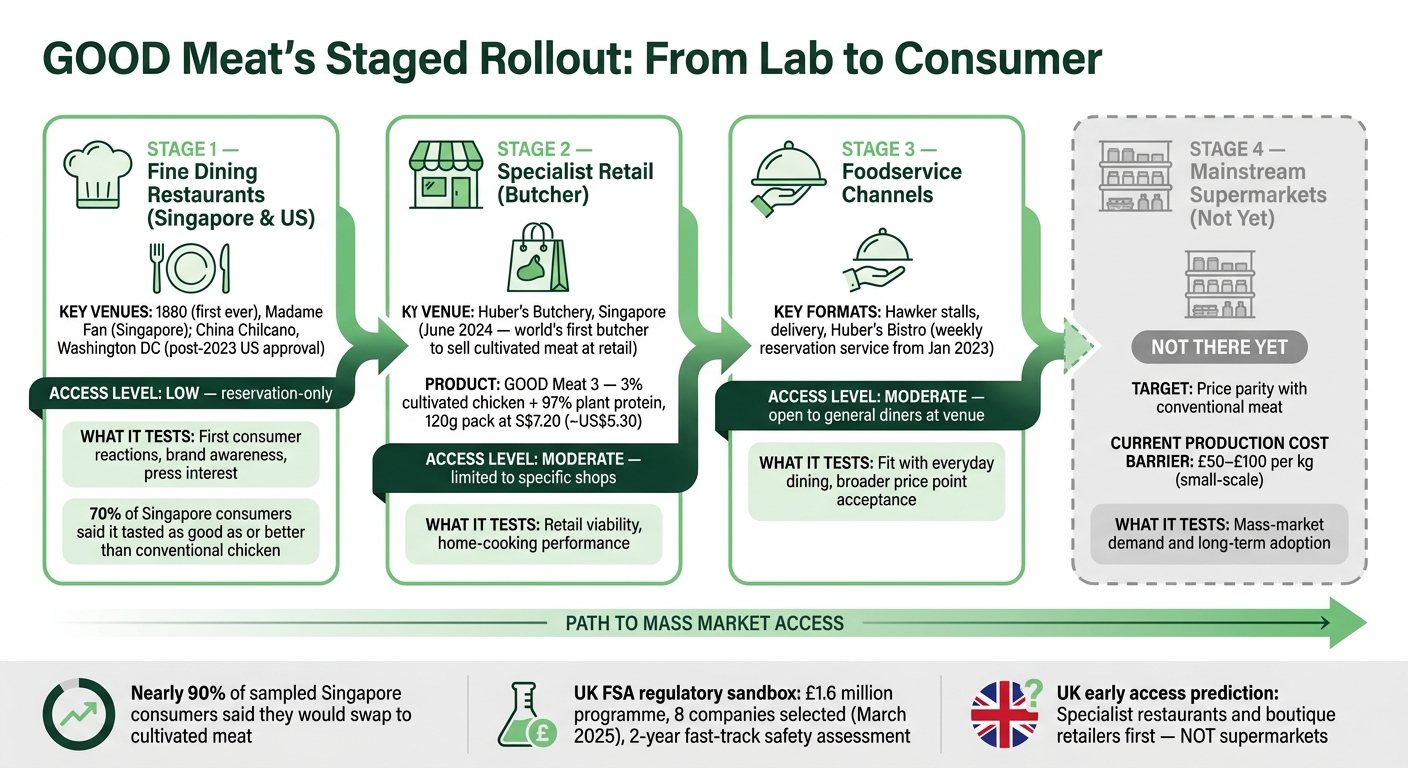
GOOD Meat's Staged Rollout: From Lab to Consumer
GOOD Meat Singapore Groundbreaking – speech by Josh Tetrick
sbb-itb-c323ed3
Quick comparison
| Channel | What people get | Access level | What it shows |
|---|---|---|---|
| Restaurants | Chef-made dishes | Low | First reactions, press interest, menu demand |
These early trials are essential for solving taste challenges before a wider rollout. | Specialist retail | Product to cook at home | Limited | Whether shoppers will buy and use it | | Foodservice | Menu items in casual settings | Limited to moderate | Fit with more regular dining | | Mainstream supermarkets | Shelf sale at scale | Not there yet | Mass-market demand and price fit |
If cultivated meat reaches Britain, I’d expect the first signs to look much more like a booked dinner in London than a pack in your local supermarket fridge.
Restaurant partnerships that introduced GOOD Meat to diners
GOOD Meat first reached diners through a small set of restaurant launches. Those first rollouts happened in Singapore.
1880 and Madame Fan in Singapore
1880 was the first restaurant to serve GOOD Meat's cultivated chicken in Singapore. Madame Fan came next, with repeat appearances on the menu that let the company test consumer interest over time [4]. That gave diners in Singapore more than a one-off trial. They had repeated chances to try it.
The same approach later moved to the US.
China Chilcano in Washington, DC
After US approval in 2023, GOOD Meat launched at China Chilcano in Washington, DC, with chef José Andrés [3]. Back in 2021, production costs were still high, so restaurants helped keep service volumes small [5]. That made them a practical starting point while the company worked through early supply limits.
Those early restaurant launches later fed into retail and broader foodservice channels. You can stay updated on new launches as more brands enter the market.
Retail and foodservice partnerships that broadened availability
Huber's Butchery and Bistro in Singapore
After its restaurant trials, GOOD Meat moved into formats that put the product closer to day-to-day shopping and dining.
In January 2023, Huber's Bistro began serving GOOD Meat once a week by reservation. Then, in June 2024, Huber's Butchery became the world's first butcher to sell Cultivated Meat at retail [1].
That two-channel setup gave people two clear ways to try it. They could order a prepared dish at the bistro, or buy it from the butcher and cook it at home. The retail launch featured GOOD Meat 3, a hybrid product made with 3% cultivated chicken and 97% plant proteins [1][6]. A 120-gram pack was priced at S$7.20, about US$5.30 [1]. Placing it in a butcher's display case helped frame it as something shoppers could pick up as part of an ordinary food shop.
Ryan Huber, Managing Director of Huber's Butchery, said:
"When we founded our butcher shop, we made it our mission to provide top quality and exceptional tasting meat products with the highest food safety standards at an affordable price. Partnering with GOOD Meat is in keeping with that vision." - Ryan Huber, Managing Director, Huber's Butchery [2]
Other Singapore foodservice channels
GOOD Meat also looked at whether the product could fit less formal, higher-volume settings.
Beyond Huber's, the company tested it through hawker stalls and delivery in Singapore [3]. Those trials gave GOOD Meat a clearer sense of which formats and price points were the best fit. Consumers can now use a product availability checker to find similar offerings.
What these partnerships mean for price, access and future UK launches
These partnerships show how GOOD Meat moves from approval to actual public access.
Why access is still limited even after approval
Approval does not mean broad availability. The main bottlenecks are low output and high production costs, which keep GOOD Meat in tightly controlled, partnership-led channels. Small-scale production costs are now estimated at between £50 and £100 per kilogram [7]. That’s why supermarket pricing isn’t on the table yet.
So instead of trying to supply everyone at once, the company sends limited product to selected venues. That gives GOOD Meat room to collect feedback, see how people respond, and avoid pushing production beyond what it can handle. It also uses a higher share of plant protein in hybrid products to stretch supply and cut cost [1].
That rollout pattern matters in the UK. Even if approval comes, early launch channels are still likely to be narrow and carefully chosen.
How early launches may look in the UK and Europe
The UK has not yet approved Cultivated Meat for sale. In March 2025, the Food Standards Agency (FSA) selected eight companies - including Mosa Meat from the Netherlands and Gourmey from France - for a two-year, £1.6 million regulatory sandbox programme designed to fast-track safety assessments [8].
That gives a pretty clear hint about what may happen next. When Cultivated Meat reaches the UK, early access is more likely to come through specialist hospitality venues, boutique retailers, or reservation-only dining than through mainstream supermarket shelves.
Partnership types compared: what each format gives consumers
Each partnership format does a different job, both for GOOD Meat and for people trying to try the product. Some formats are about publicity. Others are about testing whether people will buy it, cook it, or order it as part of a normal meal.
| Partnership Format | Consumer Experience | Ease of Access | Price Level | What It Tests |
|---|---|---|---|---|
| Fine dining / restaurants | Chef-prepared dishes in a curated setting | Low - reservation-only, specific locations | Premium | Consumer reception and brand awareness |
| Specialist retail (butcher) | Raw product to cook at home | Moderate - limited to specific shops | Mid-range | Retail viability and home-cooking performance |
| Foodservice channels | Integrated into an existing menu | Moderate - open to general diners at the venue | Mid-range | Reaching more everyday diners |
| Mainstream retail | Supermarket shelves | High - nationwide | Target: price parity with conventional meat | Long-term mass-market adoption |
In plain terms, early access is staged. It starts with premium dining, moves into small-scale retail and foodservice, and only later aims for supermarket shelves. That step-by-step path is what turns approval into something people can actually buy.
Conclusion: Key points on GOOD Meat partnerships
GOOD Meat's partnerships put cultivated chicken in places people already knew and trusted. That mattered. It gave the company a way to test demand, learn how people responded, and help shoppers and diners feel more at ease with what cultivated meat is.
Each partnership played a specific part. The fine-dining debut at 1880 in Singapore brought the product into public view in a controlled setting. The retail launch at Huber's Butchery then pushed things a step further by giving people a chance to buy it more directly, not just try it in a restaurant.
Early signs suggest that approach made sense. At the same time, demand still relied on limited retail access and careful pricing. Hybrid products such as GOOD Meat 3 also helped make those early retail sales possible while production continues to scale [1].
For UK readers, the main point is pretty simple: early Cultivated Meat launches are likely to happen in stages. They'll probably start with trusted restaurant and retail partners, then move into broader distribution as production gets better.
FAQs
Why did GOOD Meat start with restaurants?
GOOD Meat started with restaurants so people could try Cultivated Meat in a controlled dining setting. That gave the company a smart way to serve it as a high-quality dish, while also scaling production and dealing with limited supply.
Starting in restaurants also helped GOOD Meat build awareness and collect feedback on taste and appeal before moving into retail spaces such as butcher shops.
Why is GOOD Meat still hard to buy?
GOOD Meat is still hard to buy because the tech is in its early days. That makes production costly and keeps supply tight.
The big issue is scale. To make more cultivated meat, companies need very large bioreactors, and that’s where things get tricky. The industry is still dealing with tough engineering problems, including keeping oxygen levels right and managing waste inside the system.
So for now, supply goes first to select restaurants and specialist butcheries, not mass retail.
When could GOOD Meat reach the UK?
There’s still no fixed date for when GOOD Meat will arrive in the UK. While it already has regulatory approval in Singapore and the United States, it has not yet been cleared for sale in the UK.
Right now, the Food Standards Agency is moving through the approval process, which includes a two-year sandbox programme. If that process stays on track, the first Cultivated Meat products could reach the UK market by March 2027.