Governments worldwide are developing regulations to support cultivated meat, focusing on safety, labelling, and market entry. These policies are critical for ensuring consumer trust, investment confidence, and streamlined approvals. Here's a quick summary of key developments:
- Singapore: Approved the first cultivated chicken in 2020 under a novel food framework, including halal guidelines.
- United States: Dual oversight by the FDA and USDA since 2019, with cultivated chicken and salmon approved by 2025.
- United Kingdom: Approved cultivated meat for pet food in 2023, using this as a stepping stone for human food regulations.
- European Union (Netherlands): Allowed public taste tests in 2023 to gather safety and consumer data.
- Australia: Legalised cultivated meat sales in 2025 through Food Standards Australia New Zealand (FSANZ).
Despite progress, inconsistent regulations and labelling laws remain barriers. Experts recommend global standards, clear definitions, and transparent labelling to simplify approvals and build consumer trust. Public education is also key to addressing misconceptions and encouraging acceptance.
Advances in cultivated meat: Regulatory path to market (Part II of II)
Key Policies Supporting Cultivated Meat Around the World
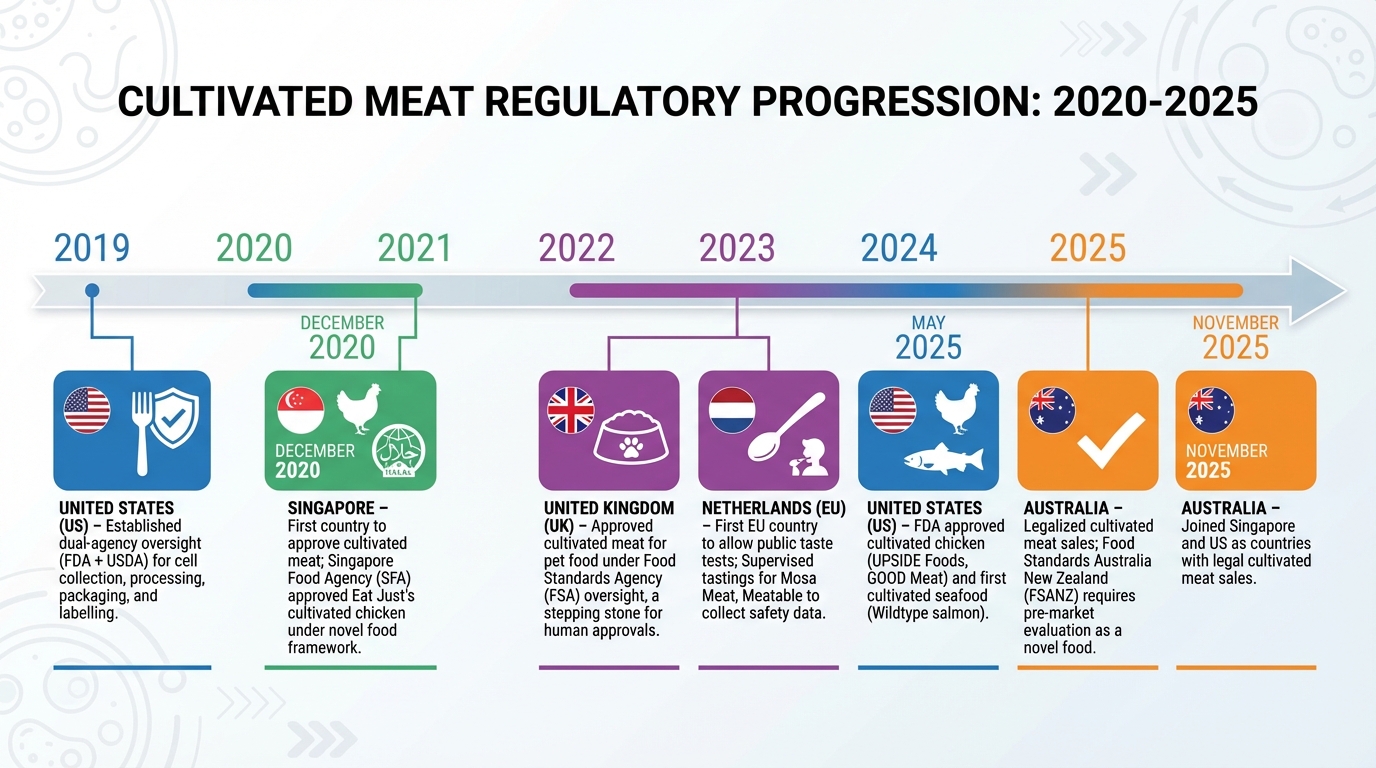
Global Cultivated Meat Regulatory Approvals Timeline 2020-2025
Governments across the globe are stepping up to create regulatory frameworks for cultivated meat, balancing the need for innovation with public safety. These early efforts not only set examples for other nations but also pave the way for broader acceptance in the market.
Singapore: Leading with the First Approval for Cultivated Chicken
Singapore made history in December 2020 when the Singapore Food Agency (SFA) approved Eat Just's cultivated chicken for commercial sale. This milestone decision was achieved under Singapore's novel food framework, which mandates stringent safety evaluations for foods without a history of human consumption. Notably, the approval also included halal-compliant guidelines, ensuring the product adhered to Islamic dietary laws without requiring animal slaughter. This move was particularly impactful in a region with a large Muslim population, positioning Singapore as a global hub for cultivated meat advancements. Many other countries are now looking to Singapore's approach as a benchmark.
United States: A Dual-Agency Regulatory Model
The United States introduced a joint oversight system in 2019, splitting responsibilities between the FDA and USDA. The FDA oversees the early stages, such as cell collection, banking, and cultivation, ensuring safety through hazard analyses and food safety plans. Once the cells are harvested, the USDA steps in to manage processing, packaging, and labelling, including the requirement for the USDA mark of inspection. By May 2025, the FDA had confirmed the safety of cultivated chicken from companies like UPSIDE Foods and GOOD Meat, along with Wildtype's cultivated salmon, marking a milestone with the first seafood approval. This collaborative framework has provided much-needed regulatory clarity, helping to speed up market readiness.
United Kingdom: Starting with Pet Food
In 2023, the UK approved cultivated meat for pet food under the guidance of the Food Standards Agency (FSA). This lower-risk category allows regulators to refine safety protocols and production processes while building confidence for human consumption approvals. For human food, cultivated meat is still governed by the UK's retained Novel Foods Regulation, requiring full pre-market authorisation. By focusing on pet food first, regulators gain practical insights into manufacturing and safety standards, which could ease the transition to human food approvals in the future.
European Union: Netherlands' Public Tastings
The Netherlands took a unique step in 2023, becoming the first EU country to allow public taste tests of cultivated meat. Companies like Mosa Meat and Meatable can now conduct supervised tastings while compiling safety data for EU-wide approval. The framework strictly regulates participant numbers, sample quantities, and traceability, ensuring a controlled environment. This approach not only helps regulators gather essential safety information but also provides valuable consumer feedback, bridging the gap between innovation and full market authorisation.
Australia: A Clear Pathway for Cultivated Meat Sales
By 2025, Australia had established a legal framework through Food Standards Australia New Zealand (FSANZ), enabling the commercial sale of cultivated meat. FSANZ treats cultivated meat as a novel food, requiring a thorough pre-market evaluation and updates to the Australia New Zealand Food Standards Code. As of November 2025, Australia joined Singapore and the United States as one of the few countries where cultivated meat is legally sold. FSANZ has also issued detailed guidance on data requirements, offering producers a transparent path to approval.
Policy Reforms Needed for Future Progress
While cultivated meat has made strides, inconsistent regulations are hindering its widespread adoption. Some regions have outright bans, while others enforce strict labelling laws, creating a fragmented regulatory landscape. This highlights the pressing need for coordinated, science-driven reforms to streamline approvals and establish consistency across borders. Such reforms could align standards and help bring cultivated meat to market more efficiently.
Standardised Definitions Across Countries
One of the most important steps is developing consistent legal definitions for cultivated meat. A 2025 analysis in The Regulatory Review points out that cultivated meat currently sits in a regulatory grey area due to the lack of a clear legal definition [3]. This ambiguity makes it difficult for agencies to determine jurisdiction, set safety standards, and classify products for trade. Experts are calling for a global standard, recommending the term "cultivated meat" to clearly describe real meat grown from cells, categorised by type. Adopting uniform definitions would simplify regulatory processes, ensure consistent safety requirements, and make cross-border trade more straightforward.
Clear Safety and Labelling Guidelines
Once definitions are standardised, clear safety and labelling guidelines are essential to build trust and ensure transparency. Rigorous labelling rules are particularly important to secure consumer confidence and maintain market access. Regulatory experts DaVault and Sinha suggest adopting biopharmaceutical-style guidelines, including measures for contamination control, step-by-step testing, and standardised harvesting techniques [3].
Labelling is another critical area. Experts recommend clear, straightforward disclosures, such as "Cell-Cultivated Beef Patty", to indicate the product's origins without using negative or misleading terms. For example, Indiana's labelling law, set to take effect in July 2027, will require products to carry a label stating, "THIS IS AN IMITATION MEAT PRODUCT", a term that could deter consumers [2]. In contrast, Arizona's HB 2739 takes a more neutral approach, mandating labels that state, "This food product is derived from cultivated cells", which promotes transparency without bias [1]. Aligning labelling standards globally would reduce the risk of misbranding and consumer confusion.
Independent Oversight and Digital Monitoring
To reduce costs and speed up regulatory approvals, experts propose integrating third-party inspections overseen by government agencies, combined with digital monitoring systems [3]. Digital platforms, inspired by practices in the biopharmaceutical industry, could enable real-time tracking of key factors like contamination levels, environmental conditions, and batch-release criteria. These platforms would use electronic records to streamline oversight and ensure compliance. DaVault and Sinha also suggest that agencies like the FDA and USDA adopt such technologies, offering tools like standardised documentation templates and pre-approval consultations [3]. These systems would enhance transparency and maintain the controlled production processes that set cultivated meat apart from traditional livestock farming.
sbb-itb-c323ed3
The Role of Public Awareness and Consumer Education
Even the best policies can fall short if people don’t fully understand cultivated meat. Building trust and acceptance hinges on transparency and education. Without clear, accessible information about how cultivated meat is made, its safety, and its advantages, misinformation and scepticism can easily spread. That’s why providing straightforward product details and comprehensive educational resources is so important for gaining consumer trust.
Transparency in Product Information
It all starts with explaining the basics: how cultivated meat is produced, why it’s safe, and how it compares to traditional meat. The US Food and Drug Administration, for instance, offers a public explainer that outlines the process of cell collection, growth, and safety evaluation - addressing common concerns head-on [4].
Labelling also plays a big role. Honest, straightforward labelling ensures consumers are informed without feeling misled or alienated. Regulatory experts DaVault and Sinha point out that explaining the production process can reassure consumers that cultivated meat adheres to strict safety standards [3][6]. Emphasising that these products are grown in sterile, controlled environments helps tackle fears about contamination. This level of transparency not only bolsters consumer confidence but also complements broader policy efforts to build trust.
Educational Platforms Driving Awareness
Education goes beyond labelling and regulatory transparency. Accessible educational resources help break down complex science into digestible content for everyday consumers. Organisations like the Good Food Institute have created materials such as articles, FAQs, and visual guides to explain how cultivated meat is produced, its impact on the environment, and the safety measures involved [6][7].
In the UK, Cultivated Meat Shop offers science-based resources covering everything from production methods to taste and sustainability. By including features like waitlist sign-ups and product previews, they’re also preparing consumers for the eventual market launch. These efforts to simplify and clarify the science behind cultivated meat align with regulatory frameworks, ensuring consumers feel informed and confident about these products.
Conclusion: Policies as Catalysts for Cultivated Meat Adoption
Strong and well-defined policies play a crucial role in ensuring the safety of cultivated meat, earning consumer trust, and paving the way for market accessibility. Singapore’s trailblazing approval of cultivated chicken highlights just how impactful clear regulations can be in opening doors for this emerging industry [6].
Still, the global regulatory scene is far from unified. Inconsistent rules and state-level bans create hurdles for investors and producers, leading to uncertainty [5]. This highlights the pressing need for international cooperation to align standards, definitions, and safety protocols. Experts like DaVault and Sinha stress the importance of comprehensive frameworks that balance innovation with safety. They recommend measures such as standardised definitions, stringent labelling requirements, and digital monitoring systems inspired by biopharmaceutical regulations [3].
But policies alone aren’t enough. Regulatory changes must go hand in hand with consumer education to combat misinformation. Transparent labelling and easy-to-understand product details can help bridge the gap between innovation and public acceptance. In the UK, platforms like Cultivated Meat Shop are stepping up by offering science-based resources. These resources break down production methods, highlight environmental benefits, and address safety concerns, helping British consumers better understand the value and purpose of cultivated meat.
As of mid-2025, at least nine countries or regions are reviewing cultivated meat products, reflecting a growing global interest [6]. Moving forward, collaboration between policymakers, industry leaders, and educators will be essential. By streamlining regulatory approvals, creating consistent standards, and raising public awareness, cultivated meat can transition from a novel concept to a widely accessible and practical alternative to traditional meat.
FAQs
What are the biggest challenges in regulating cultivated meat worldwide?
Navigating the global regulation of cultivated meat comes with its fair share of hurdles. One major challenge is setting up uniform safety standards that work across borders. Each country has its own regulatory systems, which can make the process complicated and inconsistent. On top of that, there's the task of addressing how the public views and accepts this new type of food.
Regulators also face the issue of high production costs. At the same time, they need to ensure that policies encourage environmentally responsible practices in the production of cultivated meat. Striking the right balance between these factors is critical for making cultivated meat a viable and widely accepted option.
How do regulations for cultivated meat vary across countries?
Regulations surrounding cultivated meat vary widely across the globe. In the UK, efforts are underway to establish frameworks aimed at ensuring safety, public trust, and environmental responsibility. Here, cultivated meat falls under the classification of a novel food, meaning it must pass rigorous safety evaluations before it can reach consumers.
On the other hand, countries like the United States and Singapore have moved ahead, granting approval to certain cultivated meat products and setting up defined regulatory processes. These variations highlight how different nations prioritise food safety, encourage innovation, and gauge consumer acceptance of this new food category.
Why is educating the public important for the acceptance of cultivated meat?
Public education is essential in helping people grasp that cultivated meat is indeed real meat - produced from animal cells, but without the need for slaughter. By tackling widespread misunderstandings and sharing clear, factual information, education fosters trust and builds confidence in this cutting-edge food technology.
It also sheds light on the potential advantages of cultivated meat, including its ability to lower environmental impact, bolster food security, and provide a sustainable alternative to traditional meat. As more people learn about these benefits, acceptance naturally grows, encouraging a more informed and progressive perspective on the future of food.