Cultivated beef is real beef grown from animal cells in a controlled environment, eliminating the need for farming animals. Here's a quick breakdown of its nutritional profile and how it compares to conventional beef on taste, nutrition, and safety:
- Calories: Similar to regular beef, with precise control over fat and protein levels during production.
- Protein: Contains all essential amino acids, though current prototypes may have slightly less protein than conventional meat.
- Fat Profile: Producers can adjust fat composition, reducing saturated fats and increasing healthier unsaturated fats.
- Micronutrients: Rich in iron, zinc, and vitamin B12, but some nutrients may need fortification for equivalence.
- Safety: Grown in sterile conditions, reducing risks of contamination and eliminating antibiotics.
While cultivated beef offers a comparable nutritional profile, ongoing improvements aim to match or exceed the quality of traditional beef. It also adheres to strict UK regulations, ensuring consistency and safety.
Cultivated Beef vs Conventional Beef: Nutritional Comparison
Lab grown meat is here | Is it healthy?
sbb-itb-c323ed3
1. Calorie Content Similar To Conventional Beef
One common question is whether Cultivated Beef matches the calorie count of conventional beef. The answer lies in how it's produced. Cultivated Beef is designed to align with the energy content of traditional beef by carefully controlling the balance of protein and fat during production [3].
The calorie content in meat comes almost entirely from its protein and fat. Since Cultivated Meat is grown in different bioreactor designs, producers have the unique ability to regulate the development of fat tissue - something that isn't feasible with traditional livestock farming. This means they can adjust the calorie content per 100g to hit specific targets [4].
However, early research suggests that cultivated prototypes don't always match conventional meat exactly. For instance, studies on Cultivated Chicken found that serum-free versions had 9% less protein but higher total fat and saturated fatty acids than conventional chicken breast. While this might shift the macronutrient profile, the overall calorie count often remains similar [4].
"Consumers may perceive Cultivated Meat as equivalent to conventional products; therefore, any differences in nutritional value need to be assessed." - Piotr Rzymski, Journal of Food Composition and Analysis [4]
This ability to fine-tune fat ratios isn't just about calories; it's also a key part of meeting regulatory standards. The UK Food Standards Agency, for example, requires cultivated products seeking novel food authorisation to prove they are "not nutritionally disadvantageous" compared to the meat they aim to replace [2]. To meet this standard, producers must provide detailed macronutrient data - including the protein and fat content that contributes to calorie levels - before their products can be sold in the UK. For consumers, this regulatory oversight is reassuring, as it ensures the calorie information on labels is accurate and reliable.
Next, let’s explore how Cultivated Meat compares to conventional meat in terms of protein quality.
2. High-Quality Protein With All Essential Amino Acids
When it comes to protein, quality isn't just about quantity - it's about delivering all the essential amino acids your body can't produce on its own. Cultivated beef is developed with this in mind, aiming to provide a complete amino acid profile. Early research suggests that its protein quality is on par with traditional meat. For instance, studies using porcine models have shown promising results, paving the way for further analysis of how well the body can use these proteins.
Take a 2026 study published in Food Chemistry, for example. It found that a cultivated meat sample achieved a protein digestibility of 76.86% and a hydrolysis degree of 80.01%. These numbers suggest that the amino acids in cultivated beef are absorbed efficiently by the body [1].
"Cultivated biomass exhibits an essential amino acid profile and standard protein quality indices comparable to those of conventional pork." - ScienceDirect, Food Chemistry [1]
However, there's still work to be done. Current prototypes of cultivated meat contain about 9.40% protein compared to 23.14% in conventional pork. This difference is mainly because the meat is harvested at an early developmental stage. Adjustments to the culture medium and scaffolding techniques are expected to close this gap over time [1].
On top of these improvements, cultivated meat must meet strict regulatory standards before hitting the market. In the UK, for example, the Food Standards Agency requires products to be assessed using metrics like the Digestible Indispensable Amino Acid Score (DIAAS). This ensures that the protein isn't just present in sufficient amounts but also meets established quality benchmarks [2].
3. Fat Profile That Can Be Adjusted During Production
The fat profile of Cultivated Meat plays a crucial role alongside its protein quality. One of the standout features of Cultivated Meat is the ability to customise its fat composition by tweaking the culture media - the nutrient mix that supports cell growth. In traditional farming, altering an animal's fat profile involves 60 to 70 days of dietary adjustments, and even then, the results are limited by the animal's biological constraints. Cultivated Meat bypasses these hurdles, offering a way to create fat profiles that can support heart health more effectively [6].
This precise control over fat development is a game-changer:
"An important potential advantage of cultivated meat technology is in the ability to tailor aroma and nutritional content during cell cultivation due to the direct access of the media to the cells." - Frontiers in Nutrition [6]
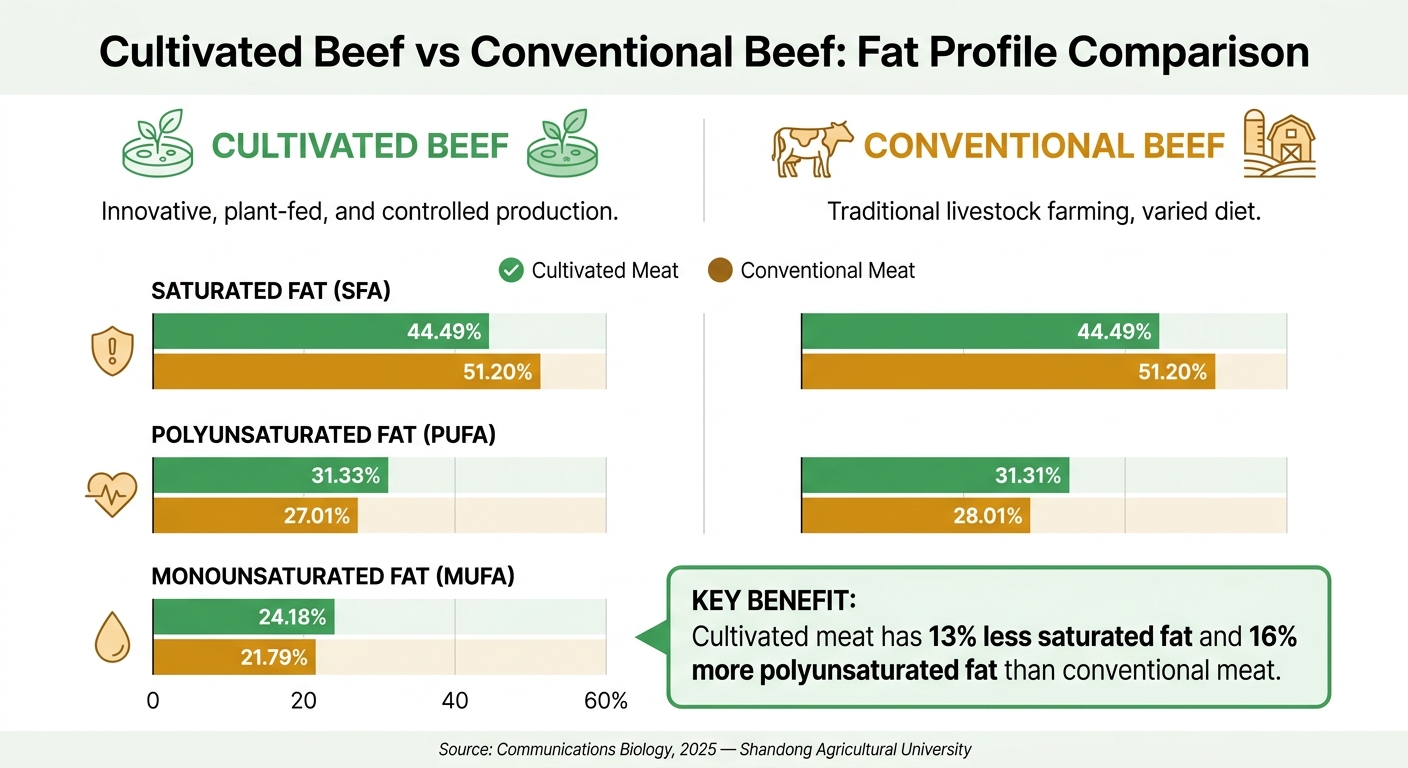
Take conventional beef, for example. It’s often high in saturated fatty acids (SFAs), which, when consumed in excess, are linked to cardiovascular problems. A 2025 study published in Communications Biology by researchers from Shandong Agricultural University explored how a food-grade inducer made from olive oil and soybean lecithin could significantly alter lipid composition. While the study focused on pig-derived samples, the findings are equally relevant to Cultivated Meat production. The modified fat profile showed notable improvements:
| Fatty Acid Type | Cultivated Meat | Conventional Meat |
|---|---|---|
| Saturated (SFA) | 44.49% | 51.20% |
| Polyunsaturated (PUFA) | 31.33% | 27.01% |
| Monounsaturated (MUFA) | 24.18% | 21.79% |
"By adjusting the fat content and fatty acid composition, we produced the meat that meets the demands of the modern diet, including a reduction in saturated fats while increasing unsaturated fats." - Communications Biology [7]
Increasing PUFA levels enhances the nutritional value of the meat but can reduce its oxidative stability, which affects shelf life. Researchers suggest that future formulations could address this trade-off by incorporating food-grade antioxidants [7]. This ability to fine-tune fat composition not only improves the nutritional profile but also paves the way for addressing the broader dietary needs discussed in the next section.
4. Key Micronutrients Including Iron, Zinc, And Vitamin B12
Conventional beef is well-known for being a rich source of crucial micronutrients like iron, zinc, and vitamin B12. These nutrients are so important that the UK Food Standards Agency (FSA) has classified them as critical. For any Cultivated Meat product to be approved for sale, it must prove that it is not nutritionally inferior to conventional beef [2].
One advantage of cultivated meat production is the ability to fine-tune its nutritional content. By adjusting the culture media - the nutrient-rich solution used to grow cells - producers can directly influence the levels of minerals and vitamins in the final product. A 2024 study published in the Journal of Food Composition and Analysis revealed that serum-free cultivated chicken contains higher levels of iron and zinc compared to conventional chicken breast [4]. This level of control ensures that cultivated meat can match or even surpass the micronutrient profile of its traditional counterpart.
Vitamin B12, however, presents a unique challenge. While minerals like iron and zinc often reach optimal levels naturally during production, vitamin B12 may require additional fortification to consistently align with the levels found in conventional beef [4]. The FSA has emphasised the importance of this:
"If the CCP's nutritional profile is not equivalent to its comparator (e.g., lower iron content than conventional meat), assess the potential impact on consumer nutritional status and provide a justification that its consumption will not adversely affect health or mitigations required." - Food Standards Agency [2]
This precise control over nutrients highlights the health potential of cultivated meat compared to traditional meat, as discussed throughout this article.
One important consideration is bioavailability - it's not just about how much iron is present, but also the form it takes. Conventional beef contains haem iron, which the body absorbs more efficiently than non-haem iron. For cultivated meat to be a true nutritional match, producers need to ensure that their iron is delivered in a similarly absorbable form. Adjustments to the culture media may be necessary to bridge this gap. Additionally, UK regulatory approval requires data from at least five independent production batches to demonstrate that nutrient levels are consistent and stable [2].
5. Fewer Contaminants and Potential Health Gains
Cultivated Meat isn’t just about nutrition - it also stands out for its safety benefits. One of its biggest strengths lies in what it doesn’t include. Traditional beef often faces risks of bacterial contamination, such as E. coli and Salmonella, which can occur during slaughter and processing. Cultivated Meat, however, is grown in sterile, closed bioreactors, cutting off these contamination risks entirely. Plus, it doesn’t require routine antibiotics. The controlled production environment also keeps out environmental pollutants like pesticides and heavy metals, while advanced monitoring systems ensure harmful compounds are detected and addressed [5].
"By demonstrating a thorough understanding of the metabolic profile and ensuring the absence of harmful substances, producers can build trust and ensure the long-term safety of cultured meat products." - Scientific Reports [5]
The safety of Cultivated Meat hinges on rigorous production standards. For instance, a recent study found traces of levofloxacin in experimental samples, underlining the importance of maintaining serum-free protocols and robust quality control measures [5].
Conclusion
These five insights show that cultivated beef offers nutritional parity with conventional beef and, in some aspects, may even surpass it. It provides similar calorie content, high-quality protein with all essential amino acids, and key nutrients like iron, zinc, and vitamin B12. Its adjustable fat content and sterile production processes also help reduce potential contaminants.
In the UK, regulators require cultivated beef to prove its nutritional equivalence to traditional beef across multiple production batches [2]. While it’s not yet available for purchase, the regulatory framework in the UK is already in place. Future versions might even include added supplements to enhance their nutritional profile.
These factors position cultivated beef as a safe and nutritionally strong alternative to traditional beef. For more details or to join the waitlist, visit Cultivated Meat Shop.
FAQs
Does cultivated beef have the same nutrition as regular beef?
Cultivated beef aims to replicate the nutritional benefits of traditional beef, providing a rich source of high-quality protein that includes all nine essential amino acids. It also delivers important nutrients such as iron, zinc, and vitamin B12. Unlike its conventional counterpart, cultivated beef production ensures a consistent nutrient profile and even offers the possibility to adjust fat and nutrient levels to meet specific dietary or health requirements.
Does it contain haem iron and enough vitamin B12?
Cultivated meat is a rich source of both haem iron and vitamin B12. The haem iron it provides is highly bioavailable, with absorption rates similar to traditional beef, ranging from 15% to 35%. As for vitamin B12, its levels are equivalent to or even higher than those in conventional meat. This is achieved by fortifying the growth medium during production. Thanks to this controlled process, cultivated meat maintains a consistent nutritional profile, delivering the same key benefits as traditional beef.
How will UK regulators check it’s safe and consistent?
UK regulators, such as the FSA and Food Standards Scotland, mandate that cultivated meat products go through a regulated product application process for approval. This involves thorough, independent safety evaluations based on HACCP (Hazard Analysis and Critical Control Points) principles. To ensure consistency, applications must include detailed compositional data, information on nutrient bioavailability, and results from testing at least five independent batches. These batches must be analysed using validated methods, with all results adhering to strict regulatory standards.