Cultivated meat is gaining momentum, and three key groups are leading the charge: flexitarians, tech enthusiasts, and eco-conscious buyers. These early adopters are shaping how this food innovation is perceived and paving the way for broader acceptance. Here's why these groups matter:
- Flexitarians: People who mostly eat plant-based diets but occasionally consume meat. They value health, variety, and reducing meat consumption without giving it up entirely. Cultivated meat appeals to their desire for ethical and sustainable choices without sacrificing taste.
- Tech Enthusiasts: Younger generations, especially Millennials and Gen Z, are drawn to the science behind cultivated meat. They embrace new technologies and are excited about its potential to improve food production and safety.
- Eco-Conscious Buyers: Focused on sustainability and animal welfare, this group sees cultivated meat as a way to significantly reduce greenhouse gas emissions, land use, and deforestation, while offering a slaughter-free alternative.
Quick Overview
| Group | Motivation | Key Traits |
|---|---|---|
| Flexitarians | Reduce meat intake | Open to alternatives, health-conscious |
| Tech Enthusiasts | Interest in innovation | Younger, tech-savvy |
| Eco-Conscious | Ethical, sustainable choices | Environmentally aware, urban |
These groups are crucial in building trust and awareness around cultivated meat. Their early adoption is expected to influence the majority, making this innovation a viable option for the future of food.
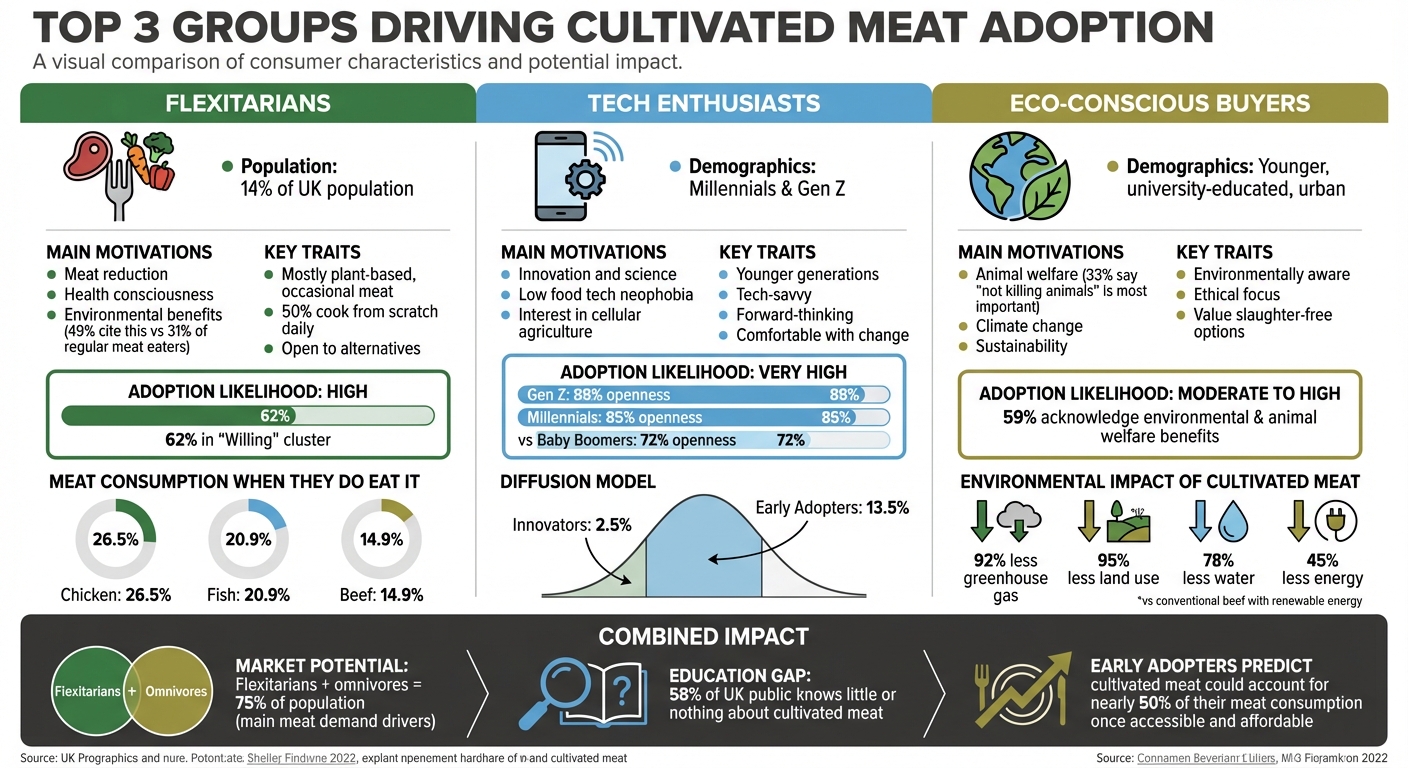
Three Key Groups Driving Cultivated Meat Adoption: Characteristics and Motivations
Flexitarians
Who are flexitarians?
Flexitarians are people who mainly follow a plant-based diet but still include meat occasionally. In the UK, they make up about 14% of the population - nearly double the combined number of pescatarians, vegetarians, and vegans [5][6].
"Our research shows that... the majority of this group are content with their current diet. They're flexitarians by choice, not because they're on a gradual path to totally foregoing meat." – Richard Moller, Director Custom Research, YouGov [6]
For most flexitarians, this lifestyle is a deliberate, long-term choice influenced by concerns about health, the environment, and animal welfare. Interestingly, half of them cook from scratch daily, often experimenting with new recipes and ingredients [6]. When they do eat meat, chicken (26.5%) and fish (20.9%) make up nearly half of their animal protein intake, while beef accounts for just 14.9% [7]. Their openness to trying new foods also makes them more likely to explore meat alternatives.
Why cultivated meat appeals to flexitarians
Cultivated meat offers the flavour and texture of traditional meat but eliminates the environmental and ethical issues tied to conventional production. These benefits resonate deeply with flexitarians. For example, 33% of consumers say that "not killing animals" is the most important advantage of cultivated meat [4], and 59% acknowledge its potential to improve animal welfare and reduce environmental impact [1]. Among flexitarians, this awareness is even more pronounced - 49% cite environmental benefits as a key motivation for choosing meat alternatives, compared to just 31% of regular meat eaters [8]. Flexitarians aren't aiming to give up meat entirely; instead, they're seeking options that align with their values while maintaining the flexibility they enjoy in their diets.
Tech Enthusiasts
The Appeal of New Technology
For tech enthusiasts, cultivated meat stands out as a breakthrough that goes beyond mimicking meat - it recreates the exact biological process that happens inside an animal, but in a controlled environment [3]. Unlike plant-based alternatives, which aim to replicate the taste and texture of meat, cultivated meat offers something fundamentally different: a genuine scientific advancement in food production.
This group is particularly drawn to the science behind it. With little hesitation around novel food technologies, tech enthusiasts are more open to ideas that disrupt traditional methods [9]. The idea of producing meat in sterile conditions, which reduces the need for antibiotics and lowers the risk of zoonotic diseases, aligns with their forward-thinking mindset [3]. Add to that the potential for meat designed at the cellular level to include healthier fats or enhanced vitamins, and it’s easy to see why this innovation resonates with them [3].
The UK is also making strides in this area. In October 2024, the UK Food Standards Agency secured £1.6 million from the Government's Engineering Biology Sandbox Fund to create safety protocols for cultivated products, with a programme set to launch in March 2025 [1]. This kind of progress fuels the enthusiasm of tech-savvy individuals, who are naturally inclined to embrace and experiment with emerging technologies.
Early Adoption and Experimentation
According to the Diffusion of Innovations model, a small percentage of the population - 2.5% classified as innovators and 13.5% as early adopters - are typically the first to embrace new technologies like cultivated meat [3]. This trend is particularly evident among tech-savvy Millennials and Gen Z, who are not only open to trying these products but are also willing to pay a premium for early access.
"Early adopters... are comfortable with change, need little persuasion to adopt a new product, and are more likely than innovators to provide reliable social proof to the later adopter groups." – Keri Szejda, PhD, School of Social and Behavioral Sciences, Arizona State University [3]
The numbers back this up: 88% of Gen Z and 85% of Millennials express at least some openness to trying cultivated meat, compared to just 72% of Baby Boomers [3]. Familiarity with cell-culture technology is a key factor in this acceptance, which explains why younger, tech-literate consumers are leading the charge. By being among the first to try and endorse these products, tech enthusiasts provide the much-needed social proof that encourages broader adoption in the future.
Is lab grown food the dinner of the future?
sbb-itb-c323ed3
Eco-Conscious Buyers
Beyond flexitarians and tech enthusiasts, eco-conscious buyers represent a significant group driving the adoption of Cultivated Meat. Their focus on sustainability and ethical practices makes this alternative particularly appealing.
Environmental Benefits of Cultivated Meat
For those prioritising sustainability, Cultivated Meat offers a compelling alternative to traditional livestock farming. When produced with renewable energy, it can emit up to 92% less greenhouse gas, use 95% less land, 78% less water, and 45% less energy compared to conventional beef. These figures highlight its potential to significantly reduce the environmental footprint of meat production. Consider this: livestock farming currently occupies 77% of global agricultural land but contributes less than 20% of the world's calorie supply. Additionally, beef production alone was responsible for over 35% of deforestation between 2001 and 2015 [10].
"The environmental, economic, and health benefits of meat grown from animal cells are clear" – Khaled Tawfik, Russ Tucker, Emma Lewis, and Ezgi Sonmez from BCG [10]
These environmental advantages resonate strongly with the growing trend towards more sustainable and responsible consumption, making Cultivated Meat a natural choice for eco-conscious individuals.
Animal Welfare Considerations
Ethical concerns also play a pivotal role in attracting eco-conscious buyers. Cultivated Meat provides a slaughter-free option, enabling people to enjoy real meat without the moral dilemmas tied to conventional farming [1]. Surveys reveal that many consumers place high value on its slaughter-free nature, further boosting its ethical appeal [4]. Labels such as "slaughter-free" and "carbon-neutral" are particularly influential in purchasing decisions.
A large portion of these buyers - often younger, university-educated, and living in urban areas - see Cultivated Meat not just as a technological advancement but as a practical step towards ethical eating and enhanced global food security. Their willingness to adopt stems from confidence in its benefits and trust in food safety regulations [1]. This strong ethical alignment positions Cultivated Meat as a solution to both environmental and animal welfare concerns.
Why These Groups Matter
Focusing on flexitarians, tech enthusiasts, and eco-conscious buyers, this section delves into why these groups collectively hold the key to the future of Cultivated Meat.
These three groups represent the early adopters - the foundation on which the Cultivated Meat market is being built. Their role is pivotal because they provide the much-needed social proof that encourages mainstream consumers to follow suit. According to the Diffusion of Innovations model, these early adopters generate the momentum required to bring the early majority (about 35% of the market) on board, making them essential to the market's growth [9].
Flexitarians and omnivores are particularly vital, as they make up roughly three-quarters of the population and drive most of the demand for meat [2]. Their willingness to try Cultivated Meat is significant; 62% of people aiming to cut back on traditional meat consumption are open to giving it a go [9]. Meanwhile, tech enthusiasts - especially Gen Z and Millennials - are even more receptive, with 85–88% expressing openness to trying Cultivated Meat [3]. Their comfort with new technologies helps break down barriers like food tech neophobia, which can deter more cautious consumers [9].
Eco-conscious buyers bring another layer of influence by highlighting concerns like animal welfare and environmental impact. While these issues resonate with many consumers, they don’t always drive purchasing decisions. However, this group elevates these concerns, shifting the conversation beyond just taste and price [2]. By doing so, they broaden the appeal of Cultivated Meat. Early adopters also predict that once these products become more accessible and affordable, Cultivated Meat could account for nearly half of their meat consumption [3]. Together, these groups are laying the groundwork for widespread acceptance.
Comparison of Early Adopter Characteristics
The table below summarises the defining traits of these groups:
| Group | Main Motivations | Key Demographics | Adoption Likelihood |
|---|---|---|---|
| Flexitarians | Meat reduction, health, variety [9] | Those reducing conventional meat [9] | High; 62% are in the "Willing" cluster [9] |
| Tech Enthusiasts | Innovation, low food tech neophobia [9] | Younger generations (Gen Z/Millennials) [3] | Very High; 85–88% openness [3] |
| Eco-Conscious Buyers | Animal welfare, climate change, land use [4] | Environmentally focused consumers [9] | Moderate to High; driven by "slaughter-free" labels [3][4] |
These groups don’t just adopt Cultivated Meat - they shape how the broader market perceives it. As Peter Cooper, Director of Global Omnibus Services at Ipsos, explains:
"With limited knowledge about cultivated, or 'lab grown' meat, there is a chance for producers to shape perceptions before it's done for them" [4].
Educational platforms like Cultivated Meat Shop are instrumental in this process. They provide clear, engaging content to help curious consumers navigate this emerging category while waiting for products to hit the shelves. Together, these early adopters and educational resources are paving the way for the early majority to embrace Cultivated Meat.
Conclusion
The analysis highlights how each early adopter group plays a distinct role in shaping the trajectory of Cultivated Meat in the market. Flexitarians, tech enthusiasts, and eco-conscious consumers are driving forces behind this growing sector. Together, they provide the momentum needed to shift Cultivated Meat from a niche innovation to a viable alternative to traditional meat.
Interestingly, early adopters anticipate that Cultivated Meat could account for nearly half of their meat consumption once it becomes widely accessible and affordable [3].
What sets these groups apart is how their strengths complement each other. Tech enthusiasts inject enthusiasm for innovation, flexitarians showcase real-world demand for alternatives, and eco-conscious consumers bring attention to issues like animal welfare and environmental concerns. As Jim Mellon, Chairman of Agronomics, aptly puts it:
"Younger people have a growing interest and open-mindedness towards clean food. These are the consumers of the future, and their values are shaping the food system of tomorrow" [11].
Together, these groups form a strong foundation for future market changes. With 58% of the UK public still knowing little or nothing about Cultivated Meat, there’s a significant opportunity to educate and engage curious consumers [4]. The Cultivated Meat Shop serves as a valuable resource, offering clear insights and keeping you informed about this evolving category.
FAQs
How is cultivated meat better for the environment than traditional meat?
Cultivated meat presents a far greener option compared to traditional meat production. Conventional livestock farming is a major contributor to environmental challenges, accounting for about 15–18% of global greenhouse gas emissions. It also takes up nearly three-quarters of the world’s agricultural land, driving deforestation, harming biodiversity, and polluting water sources.
By producing meat directly from animal cells, cultivated meat offers a way to drastically reduce these impacts. It has the potential to lower greenhouse gas emissions by up to 92% and requires around 90% less land. On top of that, it consumes approximately 78% less water, helping to conserve freshwater resources and minimise the runoff that pollutes rivers and lakes. These environmental advantages position cultivated meat as a more sustainable and resource-conscious option for the UK and beyond.
Why are tech enthusiasts excited about cultivated meat?
Tech enthusiasts are drawn to cultivated meat because it represents a leap forward in biotechnology and engineering. Advances in areas like bioreactor design, cell-culture techniques, and growth-media development have pushed large-scale production closer to reality. It’s a fascinating example of how synthetic biology and sustainable food manufacturing are evolving.
What also grabs attention is the idea of replacing traditional farming with high-tech, closed-loop systems. These systems use automation, data-driven processes, and advanced engineering to create a more efficient and controlled environment for food production. For those who are passionate about emerging technologies, this is where innovation meets practicality.
The sector’s rapid growth is further underscored by significant public and private investment. A standout example is the UK government’s £12 million commitment to cultivated meat research, signalling its potential to reshape food production. For tech-savvy individuals, this blend of cutting-edge technology, sustainability, and market momentum makes cultivated meat an exciting area to watch.
Why are flexitarians important for the adoption of cultivated meat?
Flexitarians are an important group when it comes to embracing cultivated meat. These individuals already limit their meat intake and actively look for ethical and sustainable food choices. In the UK, approximately 14% of adults identify as flexitarian, making this group far larger than vegetarians or vegans. Their willingness to explore new protein options aligns perfectly with the environmental and health benefits cultivated meat offers.
Because flexitarians only eat meat occasionally, they’re less likely to view cultivated meat as a major dietary shift. This makes it easier for them to include it in their meals. Their interest in sustainability and openness to trying new foods also positions them as potential early adopters. By embracing cultivated meat, they can help normalise its presence, sharing their experiences and encouraging others to give it a try.
As the number of flexitarians continues to grow, their role will become even more influential. They’ll drive demand, shape the market, and help establish cultivated meat as a practical option for everyday meals across the UK.