If I had to sum it up in one line: soy and wheat are the safest starting points today, pea is the main non-soy option, and rapeseed is the one to watch for albumin replacement.
If you work on cultivated meat media, the short answer is simple. I’d put the plant sources into three groups:
- Best established: soy, wheat
- Promising next step: pea, rapeseed
- Earlier-stage options: cottonseed, rice, chickpea
The article makes three points that matter most:
- Cost is a big issue, and one cited study reported a 75% cut in media cost with plant-derived hydrolysates.
- No single plant source works for every cell type or process stage.
- Processing matters as much as the crop itself. Two hydrolysates from the same plant can behave very differently.
So if you want a practical takeaway, this is it:
- Start with soy if you want the deepest research base.
- Use wheat as a support ingredient, not usually as a full serum stand-in.
- Screen pea as a non-soy option with supply appeal.
- Look at rapeseed when you need albumin replacement.
- Treat cottonseed, rice and chickpea as trial candidates until more cell-type data are in place.
Quick comparison
| Source | What it is best known for | Main issue | Where I’d place it today |
|---|---|---|---|
| Soy | Broad cell growth support | Batch variation | First-choice screen |
| Wheat | Growth support in blends | Dose sensitivity | Strong support ingredient |
| Pea | Non-soy sourcing option | Less data in key cell types | Good screening candidate |
| Rapeseed | Albumin replacement | Processing can change results | Special-use option worth testing |
| Cottonseed | Strong CHO output data | Limited cultivated meat proof | Early trial use |
| Rice | By-product feedstock option | Thin evidence base | Watch list |
| Chickpea | Serum-substitute and microcarrier work | Early-stage media data | Niche trial use |
In short, I’d read the article as a guide to what is ready now, what still needs more testing, and where each ingredient fits in a media formula.
The most established plant-based sources
Soy protein hydrolysate
Soy protein hydrolysate has the longest track record of any plant-derived supplement in this roundup. It has been tested in CHO and C2C12 cells, along with other mammalian systems, which makes it especially relevant for skeletal muscle work in Cultivated Meat production.
Its value comes from two things working together: a near-complete essential amino acid profile, and a mix of small peptides and nitrogen sources that can support cell proliferation and, in some systems, myogenic differentiation.[4][5][1] Some serum-free formulations use soy hydrolysate across a broad dose range, with a strong small-peptide fraction.[11][13] In C2C12 myoblast culture, a commercial soy protein hydrolysate, PU041, at only 0.5 g/L increased proliferation and lifted myogenic markers such as MyoD and MyHC under both normal and reduced-serum conditions.[4][5]
That said, soy is not a plug-and-play answer. It can support short-term growth, but that does not always carry over into stable long-term culture.[12] Batch variation also creates a headache. Changes in enzyme mixtures, soy source, and processing can shift amino acid profiles by 10–30% between batches, leading to swings of ±15–30% in viable cell density in CHO processes.[10][9] For media developers, batch qualification is a must. In practice, soy tends to work best as part of a blend rather than as a one-size-fits-all base.
Wheat protein hydrolysate
Wheat protein hydrolysate is usually more useful as a booster than as a standalone serum replacement. In CHO-320 cells, adding oligopeptide-enriched wheat peptone to a protein-free base medium increased maximum cell density by up to 30% and IFN-γ secretion by about 60% versus the unsupplemented control.[8] In a separate benchmarking study, CHO-K1 cells grown under reduced-serum conditions responded well to wheat peptones, with doses as low as 1 mg/mL restoring viable cell densities close to those seen with 10% FBS.[6]
That sounds strong, but the main value of wheat still seems to be in blends. Here, dose control matters more than trying to use it on its own. Push the concentration too far and you can run into side effects, including more foam, osmolarity shifts, or higher ammonia. So wheat looks less like a full replacement and more like a dial you turn to improve performance.
Pea protein hydrolysate
Pea is attractive for supply reasons, but the process evidence is still thinner. It is already used in microbiological and mammalian media as a proteose- and peptide-rich nitrogen source.[7] It is also food-grade and widely available, which fits the sustainability aims of Cultivated Meat production.
The gap is in proof for cell types that matter here. Soy and wheat have already laid out a useful playbook: test dose ranges, use blend-based strategies, and manage variability from the start. Pea fits well as a screening candidate within that framework, but it is not yet a proven media standard.
sbb-itb-c323ed3
Emerging and specialised plant sources
These options are less established than soy or wheat, but they fill more specific roles. Some can stand in for albumin. Others seem to help with growth, attachment or differentiation.
Rapeseed protein isolate and hydrolysate
Rapeseed is starting to get attention as a source for serum-free media. Its main point of interest is pretty clear: rapeseed protein isolate (RPI) has been tested as a direct replacement for albumin.
In Beefy-R medium, RPI was made from rapeseed meal through protein isolation and filtration.[14][16] At about 0.4 mg/mL, it replaced recombinant albumin and delivered around 1.15-fold efficacy for bovine satellite cell growth, while keeping normal cell phenotype and myogenic potential.[14][16]
Earlier CHO work points in a similar direction, though with an important catch. Controlled rapeseed hydrolysates have been reported to replace transferrin, albumin and insulin, and one insect-cell study found a 60% increase in maximal density.[15][18][22][30] But a different hydrolysate did not work, which makes the lesson pretty blunt: processing and peptide profile can make or break performance.[15][18][22][30]
Rapeseed still is not common in mammalian cell culture, and most of the evidence comes from tightly controlled studies. Even so, it stands out because it has a clearly shown job in media design: albumin replacement. That makes it useful when one ingredient needs to do one thing well, instead of trying to cover the whole formula.
Cottonseed, rice bran and rice protein hydrolysates
Cottonseed hydrolysate has stronger CHO data than many other newer plant sources. In one study, UPcotton hydrolysate increased monoclonal antibody titre by 166%, reaching 117 mg/L in batch culture.[29][32] It also seems to influence energy, amino acid and growth signalling pathways.[19]
Still, there are trade-offs. Raw cottonseed meal contains anti-nutritional factors, so processing has to keep those under control. And most of the data come from CHO cells, not the muscle or fat cells at the centre of Cultivated Meat cell line development. For media developers, that missing cell-type validation is the main weakness.
Rice follows a different path. The appeal here is not just performance, but the use of by-products from rice milling and protein isolation. Rice bran and rice protein hydrolysates stand out for that reason. In some formulations, rice peptides at 100–300 mg/L supported VERO cell growth comparable with 5% serum.[31][33] Rice extracts have also outperformed yeast, soy and wheat extracts in some serum-free systems.[31][33]
Rice-derived hydrolysates are still less proven than soy or wheat. But the by-product origin, plus the results already reported, make rice a source worth watching.
Chickpea and other pulse hydrolysates
Pulse hydrolysates follow a similar idea, with more focus on low-cost, food-grade inputs. Chickpea and other pulses are rich in protein and can yield a range of bioactive peptides after enzymatic hydrolysis.[17][20][21][23]
There is also some direct cell culture evidence. Chickpea protein hydrolysates made with food-grade proteases such as alcalase and flavourzyme have been described as low-cost and suitable for serum-substitute testing in certain human suspension cell lines.[3][25] For Cultivated Meat, the more interesting result is that trypsin-treated chickpea protein hydrolysate has been used to develop microcarriers that improved attachment and proliferation in several relevant cell types, including C2C12 cells, porcine myoblasts, chicken satellite cells and 3T3-L1 preadipocytes. It also supported differentiation into muscle and fat.[24][26][27][28]
Even so, chickpea hydrolysates are still at an early stage. There is limited systematic evidence on how they affect the growth and differentiation of the exact cell lines used in Cultivated Meat production, and much of the work so far has focused on nutrition and food use rather than cell culture media. Across all of these sources, one point keeps coming up: the crop matters, but the way it is processed and the peptide profile it produces matter just as much.
How these plant sources compare in practice
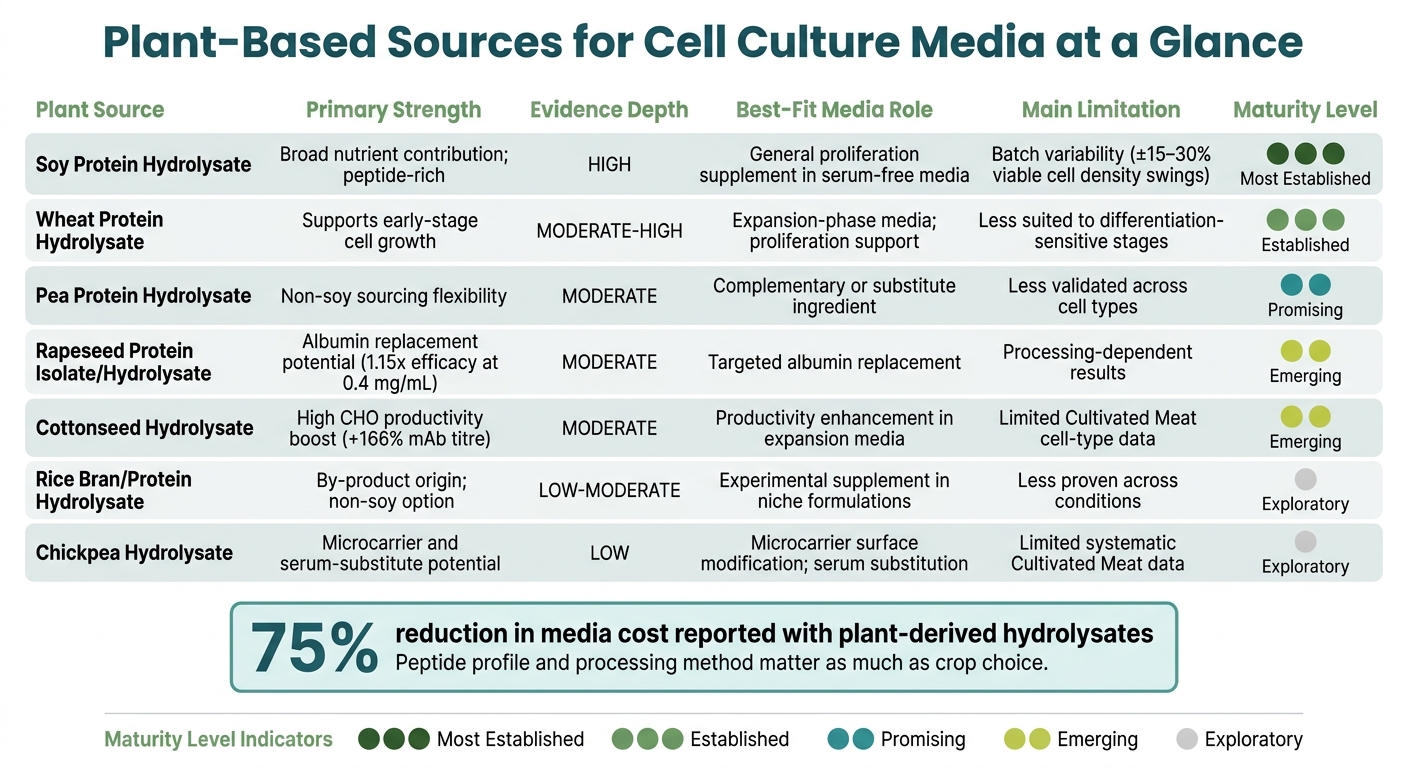
Plant-Based Sources for Cell Culture Media: Comparison Guide
Comparison of key plant sources
After reviewing each ingredient on its own, the next step is simple: which ones are closest to day-to-day use? This is where early promise turns into an actual media choice. The table below shows how each source stacks up right now.
| Plant Source | Primary Strength | Evidence Depth | Best-Fit Media Role | Main Limitation | Maturity for Cultivated Meat |
|---|---|---|---|---|---|
| Soy protein hydrolysate | Broad nutrient contribution; peptide-rich | High - widely studied in CHO and other mammalian cell systems | General proliferation supplement in serum-free media | Batch variability; peptide profile shifts with processing | Most established |
| Wheat protein hydrolysate | Supports early-stage cell growth; familiar industrial ingredient | Moderate-high - good support for proliferation | Expansion-phase media; proliferation support | Less suited to differentiation-sensitive stages | Established |
| Pea protein hydrolysate | Sourcing flexibility; non-soy alternative | Moderate - growing interest, smaller evidence base | Complementary or substitute ingredient | Less validated across cell types and process settings | Promising |
| Rapeseed protein isolate and hydrolysate | Alternative oilseed-derived peptide pool; albumin replacement potential | Moderate - strong in specific studies | Targeted albumin replacement or specialised serum-free supplement | Processing-dependent; limited validation across cell types | Emerging |
| Cottonseed hydrolysate | High productivity boost in CHO cells | Moderate - strong CHO data, limited Cultivated Meat data | Productivity enhancement in expansion media | Needs more standardisation and broader validation | Emerging |
| Rice bran and rice protein hydrolysate | By-product origin; non-soy sourcing option | Low-moderate - limited data | Experimental supplement in niche formulations | Less proven across conditions | Exploratory |
| Chickpea hydrolysate | Pulse-derived; microcarrier and serum-substitute potential | Low - early-stage | Microcarrier surface modification; serum substitution | Limited systematic data for Cultivated Meat cell lines | Exploratory |
How media developers evaluate plant sources
In practice, developers don't pick a source just because it comes from a certain crop. They look at performance, repeatability and cost. What matters is whether the ingredient helps cells attach, multiply, stay viable and then move into later differentiation.
A 2026 benchmarking study looked at six plant hydrolysates - wheat, soy, pea, broad bean, rice and a rice–pea blend - and measured how they affected proliferation under reduced serum, along with osmolality and peptide composition. [34] The results were not all the same. Some options performed better than others, and blends such as rice–pea showed a more even profile than single-source ingredients.
This is where things get tricky. Two hydrolysates from the same crop can act like two different ingredients if the degree of hydrolysis, peptide length distribution or processing conditions change. For rapeseed, for example, studies found that hydrolysates with at least 70% of peptides below 1 kDa increased CHO cell density, while less extensively hydrolysed fractions showed little positive effect. [18]
Cost and scale matter too. One study on chicken cells grown in hydrolysate-based serum-free media reported more than 70 passages, a doubling time of 1.53 days and a 75% cut in media cost compared with standard serum-containing media. [2] That sounds strong on paper, but developers still need the same result batch after batch and at scale.
That gap between a good result and a usable ingredient helps explain current choices. Teams often start with soy or wheat because the evidence base is deeper, then test pea and other sources for narrower jobs where a more targeted fit might pay off.
Conclusion: Which plant-based sources look most promising today
Based on the current evidence and how often results can be repeated, soy, wheat and pea are out in front. Soy protein hydrolysate is still the most studied plant hydrolysate in cell culture[30]. Wheat stands out because it has a strong industrial supply base and tends to perform well when specifications are kept tight. Pea is also moving up fast as a non-soy option, with more formulation support now available. Put together, these three offer the best mix of evidence, supply maturity and day-to-day use in formulation.
Beyond that front group, the next set of options looks less certain, but still worth watching. Rapeseed looks like the most interesting one right now. It has already shown albumin-replacement potential and useful results in bovine satellite cell growth, though it still needs testing across more settings. Cottonseed, rice and chickpea are at an earlier stage, with each one looking more suited to niche or trial use for now.
Performance matters, of course. But when an ingredient has to work at scale, cost often makes the final call. Low-cost plant hydrolysates matter because even economies of scale mean small savings on ingredients can add up fast across the litres of media needed per kilogram of meat[34][35].
That helps explain why work is shifting towards blends instead of single-source formulas. The most likely path forward is tailored blends matched to the cell type and the stage of the process. For now, soy, wheat and pea lead the field, while rapeseed, rice and chickpea look like the strongest part of the next wave.
FAQs
Why isn’t one plant source enough for every media formula?
A single plant source usually can't do every job in a cultivated meat growth medium.
Cell culture needs a very specific mix of nutrients and conditions. That includes carbon sources, nitrogen sources and other factors that help cells grow as expected.
And here's the catch: different plant-derived ingredients do different things well. One source might work better for carbon. Another might be more useful for nitrogen. Even waste-based inputs can shift in composition, with changes in things like acidity or ammonia levels.
That's why growth media formulas often combine several sources. It helps teams get steadier performance, especially when they need the process to work at scale.
How do manufacturers manage batch-to-batch variation in plant hydrolysates?
Manufacturers keep batch-to-batch variation in plant hydrolysates under control by using defined, food-grade ingredients and tighter quality checks when sourcing and processing raw materials. That matters because even small shifts can change nutrient content and affect how cells perform.
They also rely on consistent batch testing, close monitoring, and careful record-keeping. On top of that, they use processing methods such as filtration to standardise composition and cut impurities that can interfere with cell growth.
Which plant source is best for muscle cell growth versus albumin replacement?
For muscle cell growth, the article points to plant-derived scaffolds that copy the structure of tissue. A good fit here is fibrous plant by-products, especially corn husks and jackfruit rind.
For albumin replacement, it highlights plant-based substitutes such as rapeseed and chickpeas. These could serve as alternatives to costly albumin in cell culture media.