If cultivated meat is going to reach supermarket shelves, companies need a way to share key production tools without giving away ownership. That is what a technology sharing agreement does.
I’d sum it up like this:
- It is a contract that lets one party use another party’s know-how, IP, or production methods
- Ownership stays put, unlike a sale
- In cultivated meat, it often covers cell lines, media, bioreactor methods, QC steps, and process design
- The main rules usually cover use, territory, product limits, secrecy, fees, and who gets any new data or process changes
- Why it matters: it can cut trial-and-error work, support traceability and compliance, and help firms prepare for regulatory review
- Why shoppers should care: these deals can affect price, how soon products arrive, supply stability, and product range
A few points stand out from the article:
- In April 2026, Max Planck Institute and Innocent Meat started a joint project using high-density perfusion on proprietary cell lines to increase yields
- In the UK, the FSA is using regulatory sandboxes, with the aim of cultivated meat reaching supermarkets by 2027
- Shared work on growth media has helped bring some production costs down to roughly £8–£12 per kilogram
For me, the plain-English takeaway is simple: these agreements sit in the background, but they can shape what cultivated meat costs, how safely it is tracked, and how much choice you may get at the shop.
What is a technology sharing agreement?
A technology sharing agreement is a contract that allows one party to use another party’s technology, know-how or IP under set terms, while ownership stays with the original owner. In Cultivated Meat, that often means sharing the parts of production that are hardest to build alone.
In the Cultivated Meat sector, these agreements often cover cell lines, media formulations, bioreactor methods and production processes. These are the tools that help move Cultivated Meat from research to scale.
Technology sharing is not the same as selling technology
When technology is sold, ownership transfers for good. A technology sharing agreement gives limited use under defined conditions, while the original owner keeps control.
Companies often separate core IP from non-core IP. They are usually more open to sharing non-core IP with research partners. That lets them work together without giving up competitive edge.
What can be shared in Cultivated Meat
The most common examples are practical, production-critical tools rather than finished products. In Cultivated Meat, shared assets often include:
- cell lines
- media formulations
- bioreactor methods
- quality-control protocols
- production-process designs
sbb-itb-c323ed3
How do technology sharing agreements work?
They spell out who can use shared technology, under what terms, and what remains protected. Every agreement has its own detail, but most of them revolve around access, confidentiality and how improvements are handled. In Cultivated Meat, the scope is often tight. That’s especially true for cell lines, species and production processes. In most cases, the main limits deal with use, territory, product scope and ownership of improvements.
Licences, territories and product limits
In practice, the agreement draws clear lines around each cell line, process and market. Cell lines are usually developed in-house and treated as proprietary IP, so outside access for research or production tends to happen through formal industry collaborations [2].
The terms can also be species-specific. A partner might get access to only certain cell lines, a narrow set of products or a defined production method. Some partnerships go even further and focus on process intensification. In that setup, teams use existing cell lines, media and protocols to spot bottlenecks and increase cell density in specific reactor systems [4].
Fees, confidentiality and ownership of improvements
The commercial terms vary, but confidentiality and ownership of improvements often do most of the heavy lifting. Companies are often prepared to share non-core IP with academic groups or partners when that can support new work without giving away the parts that matter most to their competitive edge [1].
Ownership of improvements is usually handled with care. Many agreements tie all generated data directly to the cell line used, so any new data stays linked to the original cell line [2]. They also tend to require batch-level records for growth factors, media and plastics. That way, regulators can trace outputs back to the original cell line [1][2].
Why do technology sharing agreements matter in the Cultivated Meat industry?
Technology sharing agreements give firms a way to share specialist know-how without handing over control. In the Cultivated Meat industry, that matters most in two places: speeding up scale-up and making regulatory work less messy.
How they can speed up product development and scale-up
If a company gets access to proven bioprocess methods through a formal agreement, it can skip a lot of trial and error at industrial scale. That means less rework, fewer dead ends, and a better shot at moving from lab success to food-scale output.
One direct effect is joint work on production bottlenecks. In April 2026, the Max Planck Institute for Dynamics of Complex Technical Systems and Innocent Meat launched a joint project using high-density perfusion methods on Innocent Meat's proprietary cell lines to identify bottlenecks and increase cell yields for food-scale output [4].
How they can support local production and regulatory progress
These agreements also make it easier to get the paperwork and systems in place that regulators want to see. The CARMA Hub, led by the University of Bath and including the University of Birmingham and University College London, is a strong UK example [1]. Through a consultative network, industrial partners share knowledge with academic researchers, which helps apply Cultivated Meat methods in UK production while firms keep control of their core IP.
That kind of setup can help from day one. Instead of each company figuring everything out alone, partners can align on documentation standards and compliance know-how early, including:
- cell line history
- raw material traceability
- batch-level records
In the UK, the Food Standards Agency (FSA) is using regulatory sandboxes to facilitate the approval of Cultivated Meat products, with the aim of supermarket availability by 2027 [5]. When teams share compliance know-how from the outset, regulatory preparation tends to be more straightforward.
What do technology sharing agreements mean for future shoppers?
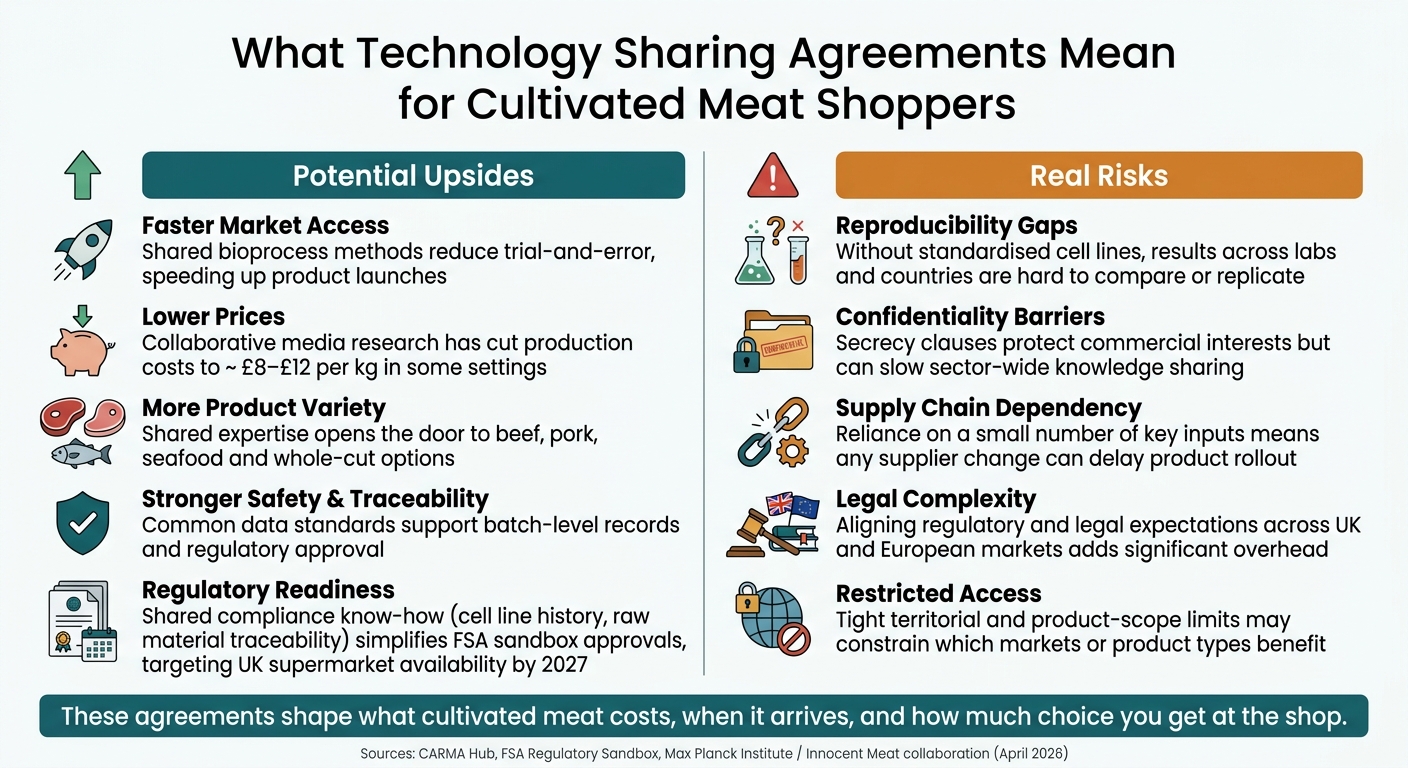
Technology Sharing Agreements in Cultivated Meat: Benefits vs Challenges for Shoppers
Licensing and IP details can sound a world away from the supermarket aisle. But they shape what ends up on the shelf. They affect price, timing, and how steady supply is from one batch to the next.
Benefits: more variety, faster access and shared expertise
When companies share methods, they can move from development to market with less friction and lower costs. That can help make Cultivated Meat more affordable.
Shared data standards and better record-keeping also support safety, traceability, and regulatory approval. That matters because food products don't just need to be made well. They need to be tracked, checked, and approved in a way regulators can follow.
As technical know-how spreads, companies can build on what already works instead of starting from scratch each time. That can open the door to a broader mix of products, including whole cuts and cultivated seafood.
Challenges: complex contracts, secrecy and dependency
There’s a snag, though. Without standardised cell lines, research done in different labs or countries can be hard to compare or build on. One team may get useful results, but another may struggle to repeat them under a different setup.
Confidentiality clauses can also get in the way. They protect commercial interests, which makes sense, but they can slow the kind of open knowledge-sharing that helps the sector move forward as a whole.
Supply dependence is another issue. If a company relies on a small number of key inputs, any change to those inputs can mean changing suppliers, processes, or both. That takes time and can affect product rollout.
Then there’s the legal side. Aligning regulatory and legal expectations across markets like the UK and Europe adds yet another layer of complexity.
For shoppers, the trade-off is pretty plain:
- Possible upsides: faster access, lower prices, and more choice
- Real risks: slower deals, secrecy, and dependence on supply chains
Why technology sharing agreements matter for Cultivated Meat shoppers
Technology sharing agreements can sound like the sort of thing that only matters to lawyers and lab teams. But they shape what ends up on shelves, when it gets there, and what you may pay for it. In plain terms, they affect price, timing and choice.
One clear example is growth media. Shared progress here has already helped cut production costs to about £8–£12 per kilogram in some joint commercial settings [3].
These agreements also help set common rules for traceability and quality checks. When companies work together faster, products can reach the market sooner. That can mean more options for shoppers, including beef, pork and seafood, along with steadier quality and safety [1][2].
For shoppers, the main point is simple: these deals can speed up access, expand choice and make product quality more consistent.
FAQs
Who signs these agreements?
In the Cultivated Meat sector, technology sharing agreements are usually signed between research institutions, such as universities, and commercial biotech companies.
In many cases, a university’s technology transfer office handles the legal side of the deal. That usually means sorting out the terms, protecting intellectual property, and making sure both sides are working towards the same goal.
For start-ups, this kind of agreement can open doors. It may provide access to proprietary cell lines, media formulations, or bioprocessing expertise that would otherwise be hard, slow, or costly to develop in-house.
Can shared technology slow innovation?
No. In the cultivated meat industry, sharing technology tends to speed things up, not slow them down.
When companies share non-core intellectual property, research tools and open-source data, other teams don't have to do the same work all over again. That can save start-ups a lot of time and, in some cases, millions of pounds.
It also gives companies and research institutions a way to pool knowledge, equipment and resources, which can help them deal with technical barriers with less wasted effort.
Will this lower Cultivated Meat prices?
Yes. Technology sharing agreements and similar partnerships can help lower Cultivated Meat prices by cutting infrastructure costs, including bioreactors and research laboratories.
They also let companies team up on major cost-saving areas, such as lower-cost serum-free growth media and scalable cell lines. That can reduce duplicated research and improve efficiency.