Global cultivated meat summits are driving the future of alternative proteins by connecting experts to solve challenges in scaling production, reducing costs, and navigating regulations. These events bring together scientists, investors, regulators, and industry leaders to align efforts and accelerate progress.
Key Takeaways:
- Purpose: Address technical, regulatory, and commercial hurdles for cultivated meat.
- Focus Areas: Cost reduction, scaling production, regulatory alignment, and public trust.
-
Notable Summits in 2026:
- Chicago (Feb): Focus on scaling in the Americas, AI applications, and facility development.
- Amsterdam (Nov): Spotlight on EU regulations and startup-investor collaboration.
- Industrialising Summit: Technical focus on bioreactor design and supply chain optimisation.
Summits also explore factors shaping consumer acceptance and sustainability data, ensuring cultivated meat becomes a viable option for feeding a growing global population. With increasing collaboration across regions and sectors, these gatherings are shaping the path from lab to market.
IFST Webinar: Cultivated Meat - Challenges and Innovation in the Sector
sbb-itb-c323ed3
Major Global Cultivated Meat Summits
Here’s a look at some key global events shaping the future of cultivated meat.
Cultured Meat Symposium Chicago 2026
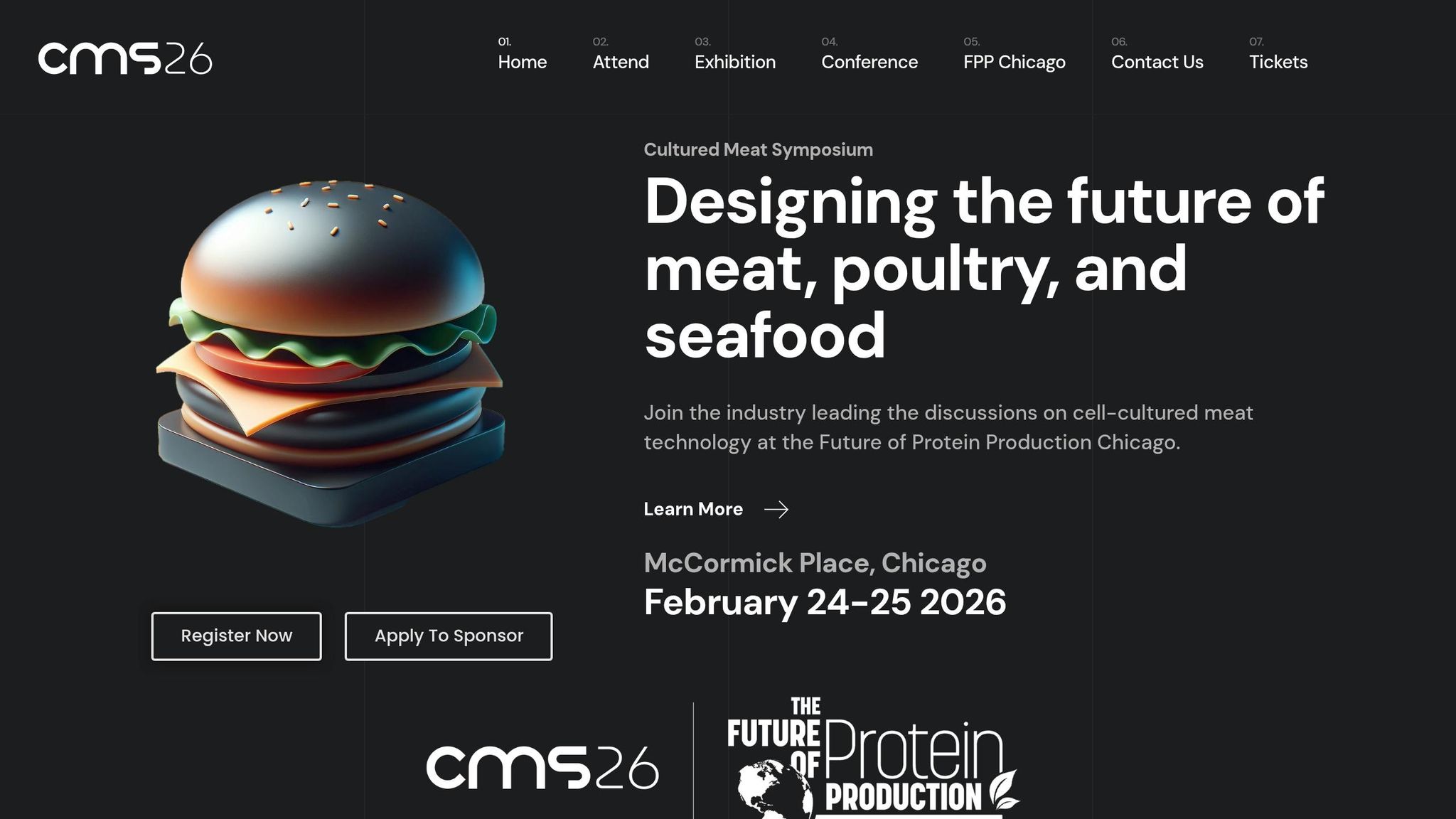
Set to take place on 24–25 February 2026 in Chicago, this symposium is focused on fast-tracking commercialisation efforts across the Americas. With over 500 delegates, 40 exhibitors, and more than 100 expert speakers expected, the event will tackle the challenges of scaling production [5]. Topics include transitioning from pilot projects to full-scale manufacturing, leveraging AI, market entry strategies, and facility development.
"AI isn't just a buzzword in alt protein. It's becoming a powerful tool for tackling real-world bottlenecks in cultivated and fermentation-enabled meat." – Future of Protein Production [5]
Tickets for full delegate passes are priced at $1,245 (around £980), with early-bird discounts offering savings of up to $500. Reduced rates are available for academic institutions, non-profits, and NGOs. A dedicated app will also help attendees network before the event [5].
Cultured Meat Symposium Amsterdam 2026
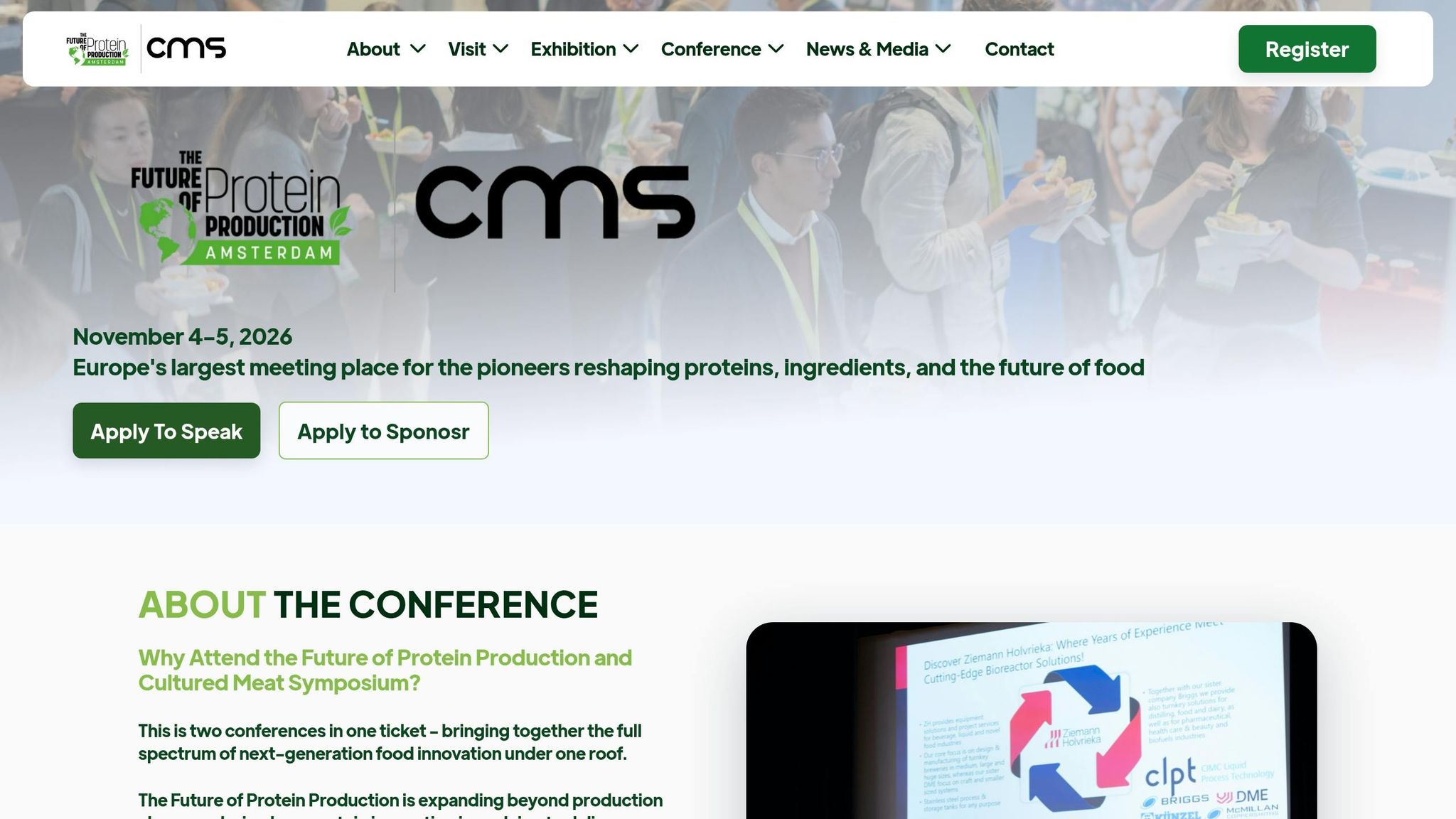
Scheduled for 4–5 November 2026, this Amsterdam event is the leading platform for cultivated meat commercialisation in Europe. It’s expected to draw over 1,000 attendees and 60+ exhibitors. A highlight of the event is the "Startup Innovation Zone", which connects emerging companies with investors and established food brands. Sessions will cover Europe's regulatory framework, offering insights into navigating EU approval processes, as well as showcasing scientific advancements in cellular agriculture [5].
The focus on engineering innovation seen here continues into the next summit.
7th Industrialising Cultivated Meat & Seafood Summit
This summit takes a deep dive into the engineering hurdles of scaling cultivated meat production. Topics include bioprocessing advancements, bioreactor design, and the development of "Tomorrow's Factories." Attendees will explore cutting-edge manufacturing techniques, automation, and supply chain optimisation - key factors in moving from small-scale production to commercial success [5].
"Scaling up from lab to commercial production is one of the biggest challenges in the alternative protein industry." – Future of Protein Production [5]
The event also gathers infrastructure and supply chain experts, including specialists in bioreactors, culture media, and scaffolding materials, to address obstacles in scaling from pilot projects to full-scale manufacturing [6].
These summits highlight the collective efforts driving cultivated meat from concept to commercial reality, each offering distinct insights to shape the future of the industry.
Summit Comparison
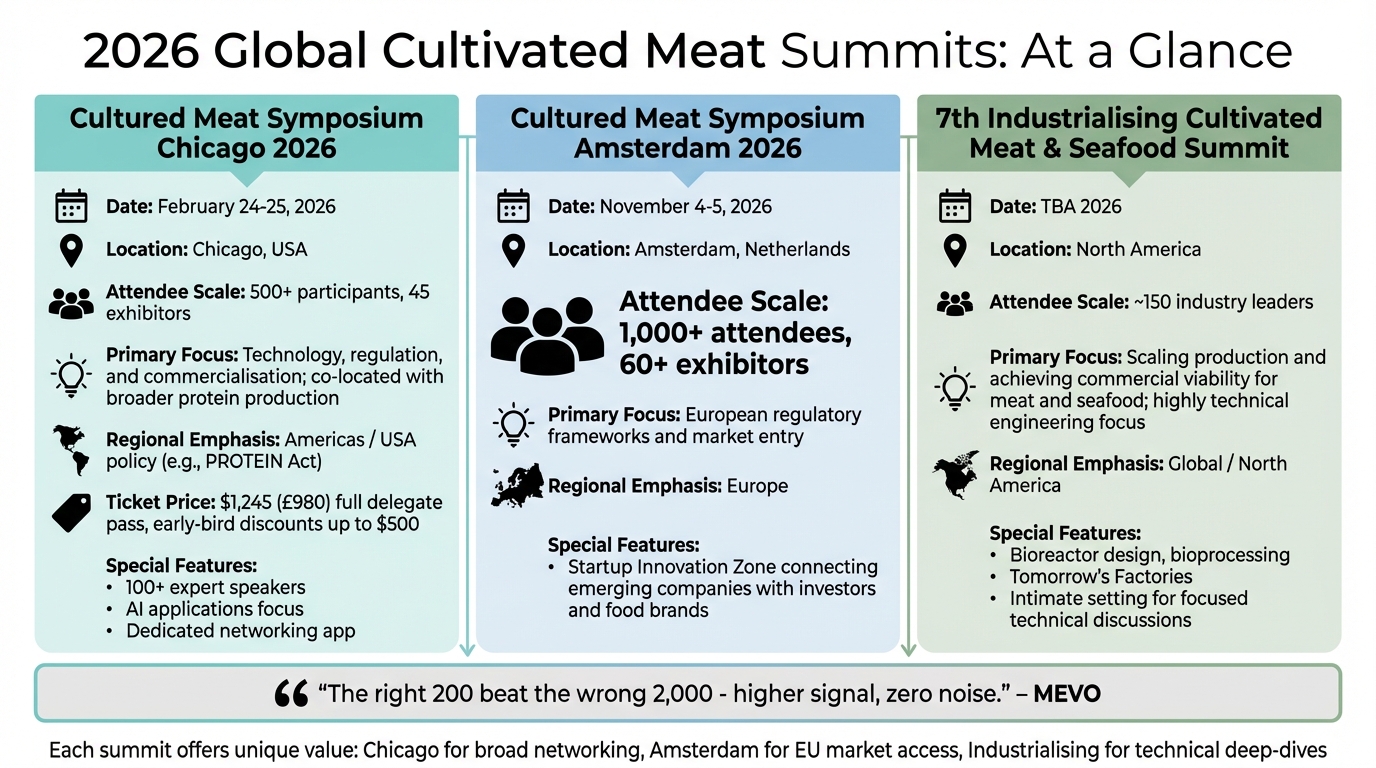
2026 Global Cultivated Meat Summit Comparison: Chicago, Amsterdam, and Industrialising Events
Summit Comparison Table
Each summit brings its unique angle to advancing the cultivated meat industry. Here's a closer look at how the three major events stack up:
| Summit Name | Date | Location | Attendee Scale | Primary Focus | Regional Emphasis |
|---|---|---|---|---|---|
| Cultured Meat Symposium Chicago 2026 | 24–25 February 2026 | Chicago, USA | 500+ participants, 45 exhibitors | Technology, regulation, and commercialisation; co-located with broader protein production [8][3] | Americas / USA policy (e.g., PROTEIN Act) |
| Cultured Meat Symposium Amsterdam 2026 | TBA | Amsterdam, Netherlands | Not specified | European regulatory frameworks and market entry [3] | Europe |
| 7th Industrialising Cultivated Meat & Seafood Summit | TBA | North America | ~150 industry leaders | Scaling production and achieving commercial viability for meat and seafood [7] | Global / North America |
The table outlines the main distinctions, but let's dive into the specifics to understand what sets these summits apart.
The Chicago summit takes a broad approach, integrating cultivated meat with other protein production methods like fermentation, plant-based alternatives, and biomanufacturing [8]. This broader focus reflects the growing trend of hybrid products and shared production infrastructure, making it a key event for those interested in the intersection of these technologies.
Amsterdam's event, on the other hand, zeroes in on the European market. With sessions dedicated to navigating the EU's regulatory landscape, it's an essential stop for anyone looking to break into Europe’s cultivated meat industry.
Meanwhile, the Industrialising Summit stands out for its highly technical focus. It dives deeply into engineering and scaling challenges, with dedicated discussions on cultivated seafood market entry alongside meat. Its smaller, more exclusive setting targets high-level decision-makers working on achieving commercial viability [7].
"The right 200 beat the wrong 2,000 - higher signal, zero noise." – MEVO [1]
The size of the event plays a significant role in shaping its dynamics. Chicago’s larger scale, with 500+ participants, offers extensive networking opportunities and a wide range of perspectives. In contrast, the Industrialising Summit’s smaller group of around 150 participants fosters an intimate environment for focused technical discussions and direct industry engagement [7][8].
Each of these events plays a distinct role in moving cultivated meat from research to commercial reality, catering to different priorities within the industry. Whether it's broad networking, targeted market insights, or deep technical dives, there’s something valuable for every stakeholder.
Recent Trends and Outcomes
Common Themes Across Summits
When it comes to cultivated meat, three major hurdles keep coming up at every key summit in 2026: taste, cost, and trust [10]. These challenges form the backbone of discussions about how to make cultivated meat a mainstream choice [10].
The conversation about scaling production has shifted significantly. Instead of focusing solely on building massive centralised facilities, there’s growing interest in "scaling out" through smaller, localised operations. This distributed model, as highlighted by Professor David Kaplan at the March 2026 Bezos Centre for Sustainable Protein Conference, could prevent the industry from being monopolised by a few large corporations [10]. It also opens the door for traditional farmers to stay involved, as seen with Respect Farms in the Netherlands, which has integrated a pilot cultivated meat unit into a working dairy farm [10].
Dr. Izzy Webb from the UK Department for Science, Innovation and Technology summed up the challenge of scaling biological processes perfectly:
"Biology doesn't scale neatly. You can't just build a bigger fermenter and it will know your work." [10]
Regulation has also become a hot topic. Far from being seen as a mere obstacle, many now view solid regulatory frameworks as critical for earning consumer trust. Rebecca Sudworth, Director of Policy at the Food Standards Agency, put it this way:
"Regulation is existential for innovators... because without good regulation you can't build the consumer trust and confidence that something new they've not encountered before is safe to eat." [10]
On the technology front, cultivated fats are emerging as a key focus. These fats are crucial for replicating the aroma and mouthfeel of traditional meat [10]. Meanwhile, advancements in AI and machine learning are speeding up progress. For instance, genome sequencing costs have plummeted to under £80, enabling researchers to generate large biological datasets and refine metabolic modelling faster than ever [10].
These trends are naturally leading to stronger collaborations across the industry.
Integration with Broader Protein Events
Cultivated meat summits are no longer standalone affairs - they’re increasingly merging with larger alternative protein conferences. These events also cover areas like precision fermentation, microbial proteins, and plant-based innovations [10]. This cross-industry collaboration is helping align efforts to scale production and establish clear regulations. It’s also bringing together surprising partnerships, such as traditional meat companies working alongside tech leaders like Google DeepMind, which is applying its AI expertise to biological research [10].
One example of this integration is the co-location of events at Chicago 2026 [3]. Similarly, Meatable’s global summit in February 2025 in Leiden, Netherlands, brought together 80 influential figures, including former UK Energy Minister Chris Skidmore and Chef Andrew Hunter. Attendees explored lab facilities, sampled cultivated products, and formed strategic alliances aimed at tackling the challenge of feeding a projected 10 billion people by 2050 [4].
Jeff Tripician, CEO of Meatable, captured the spirit of these gatherings:
"Action is what drives real progress. By bringing together industry pioneers, we are forging partnerships that will shape the future of food." [4]
Impact on Consumer Awareness
As the industry grows more interconnected, the ripple effects are being felt by consumers.
Summits are playing a vital role in making cultivated meat less of a mystery to the public. Research shows that when the sustainability benefits - like 78–96% fewer greenhouse gas emissions and 99% less land use [12] - are clearly communicated, people are much more open to trying cultivated meat [11][12]. The industry has learned from past mistakes, such as the negative public reaction to GMOs, that transparency is key.
With global meat consumption hitting new highs every year since 1961 [13], these sustainability stats are resonating with both consumers and policymakers. At the March 2026 Bezos Centre for Sustainable Protein Conference in London, over 600 participants - including scientists, startups, investors, and policymakers - gathered to address these issues [10]. These events don’t just educate industry insiders; they also spark public conversations through media coverage and social media buzz.
Making a strong first impression with consumers has become a priority. A growing trend is to launch cultivated meat products at Michelin-starred restaurants after major summit announcements. This ensures that the first public experience with the product is of the highest quality, generating positive media attention [11]. Surveys show that about 66% of consumers are willing to try cultivated meat, but much depends on how the technology is introduced and explained [11].
Conclusion
Main Points
Global cultivated meat summits are playing a crucial role in advancing the industry. These events have shown how science, policy, investment, and public dialogue come together to push cultivated meat forward. By combining scientific innovation with policy discussions, they are paving the way for better regulatory alignment and stronger collaboration across sectors.
These summits address the industry's key challenges, such as scaling production, cutting costs, and developing regulatory frameworks. They have created opportunities for direct conversations between regulators and innovators, helping to build the trust needed for market success.
Collaboration across sectors is gaining momentum. For example, the Biomanufacturing Conference 2025 in Malaysia brought together 160 participants, including representatives from the Thailand Food & Drug Administration and the Japan Association for Cellular Agriculture [9]. These global connections are helping align regulatory standards, especially in the Asia-Pacific region, where Halal certification adds an extra layer of complexity [9]. As these international partnerships grow, their impact on consumer confidence and market readiness becomes increasingly clear.
Consumer awareness is also being boosted through these summits. Attendees have become advocates for the industry after experiencing activities like live lab tours, product tastings, and panel discussions featuring diverse perspectives. In the UK, the decade-long Cultivate forum has been a leader in this approach, uniting academics, industry experts, and the public to explore cultivated meat's effects on people, the planet, and profits [2]. Efforts like these ensure that cultivated meat remains a safe, sustainable, and appealing option for consumers - a mission that Cultivated Meat Shop highlights for those curious about this emerging field.
As these events grow across Europe and North America, they are shaping an industry poised to help feed 10 billion people by 2050 [4], all while significantly reducing environmental impact. The partnerships, regulations, and public trust developed at these summits will play a key role in determining how soon cultivated meat becomes a part of everyday life. These gatherings not only accelerate progress but also empower consumers to understand and embrace the future of cultivated meat.
FAQs
Which summit is best for my goals in cultivated meat?
The best summit for you depends on your interests and priorities:
- If you're into scientific research, check out the International Scientific Conference on Cultured Meat (ISCCM) in Maastricht, happening from 17–19 November 2024. It dives into the major effects cultivated meat could have.
- For networking within the industry, the 6th Industrialising Cultivated Meat & Seafood Summit in Boston (27–29 August 2024) is all about achieving commercial goals.
- Looking to engage in policy discussions? The Meatable Global Summit in Leiden on 13 February 2025 is the place to be.
- For those focused on manufacturing advancements, London’s CARMA Conference 2025 offers a spotlight on innovation.
What does “scaling out” mean, and why does it matter?
In the world of cultivated meat, “scaling out” refers to moving production from small, experimental setups to larger facilities capable of commercial output. This process includes constructing new production plants, advancing bioreactor technology, and establishing efficient supply chains for large-scale manufacturing.
This step is essential for making cultivated meat more accessible and cost-effective. By achieving this, cultivated meat can compete with traditional meat, support global demand, and contribute to environmental goals, paving the way for broader acceptance.
How do regulators affect when cultivated meat reaches shops?
Regulators play a crucial role in deciding when cultivated meat will hit supermarket shelves. They are responsible for setting safety standards, defining approval procedures, and determining labelling rules. These frameworks differ from country to country, which can either accelerate or slow down the path to commercial availability. For example, the UK is currently working on advancing its safety standards, whereas the US has already approved cultivated chicken and salmon. The journey forward hinges on finding the right balance between safety, openness, and innovation, all while tackling trade barriers and intellectual property challenges.