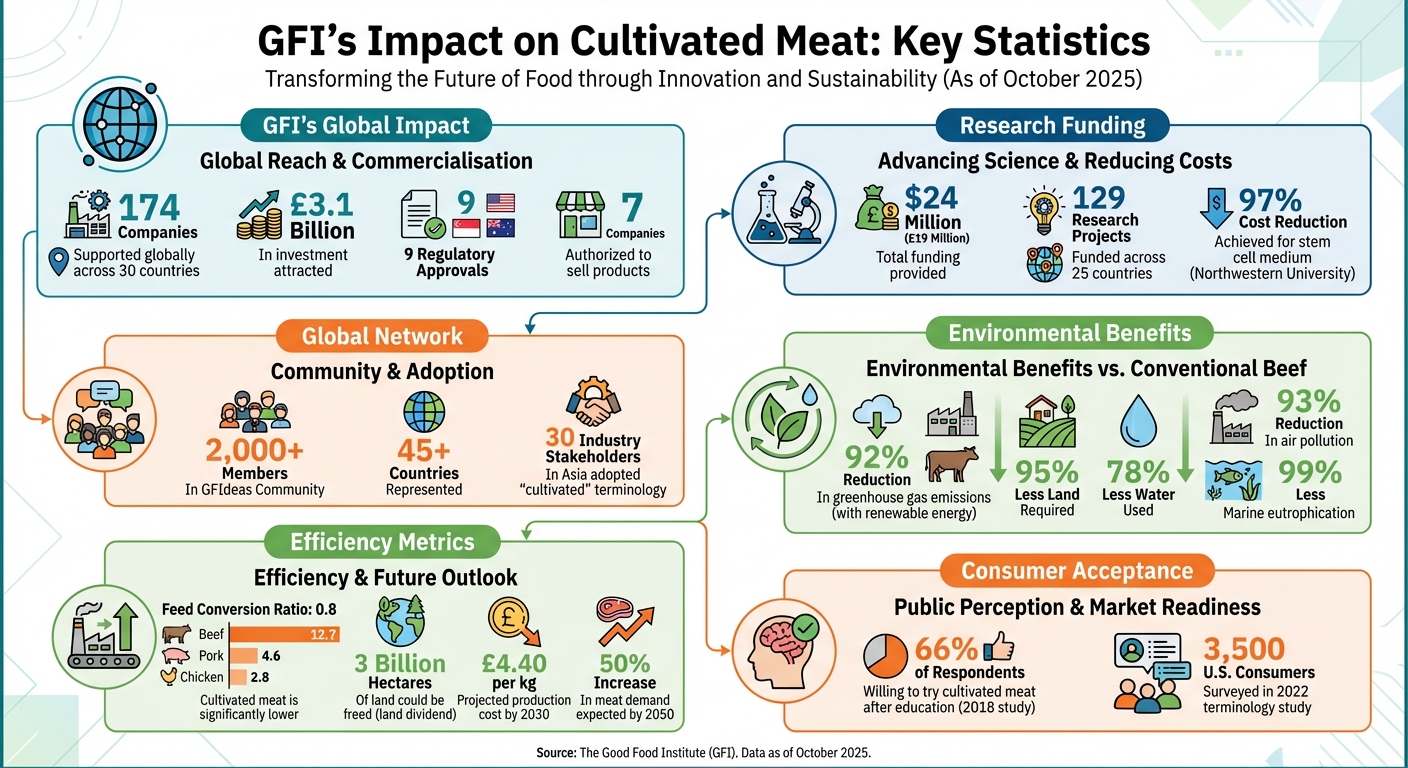
The Good Food Institute (GFI) plays a critical role in advancing cultivated meat and alternative proteins. Its focus spans funding open-access research, shaping government regulations, and supporting industry growth. By late 2025, GFI had supported 174 companies globally, enabling regulatory approvals in countries like the US, Singapore, and Australia. Key achievements include reducing research costs through publicly available resources and promoting the term "cultivated meat" for consumer clarity. GFI also highlights cultivated meat's potential to reduce greenhouse gas emissions by up to 92% and use 95% less land than conventional beef. Through research, policy efforts, and public education, GFI is driving progress in the future of food.
Good Food Institute Impact: Key Statistics and Environmental Benefits of Cultivated Meat
2024 State of the Industry: Cultivated meat, seafood, and ingredients
What the Good Food Institute Does
The Good Food Institute (GFI) is a philanthropic organisation with a straightforward mission: to make cultivated meat as affordable and accessible as traditional meat. Unlike commercial companies that focus on their own products, GFI takes on broader, system-wide challenges. From funding foundational research to influencing government policies, the organisation works on issues that no single company can tackle alone [1].
GFI's efforts revolve around three core areas. Its Science team identifies technical hurdles and funds research aimed at improving the price and taste of cultivated meat. The Policy team collaborates with regulatory bodies to create fair, science-driven approval processes and pushes for government funding. Meanwhile, the Industry team provides market insights and encourages private investments across the supply chain [1]. Together, these initiatives span research, regulation, and public education, which are explored in more detail below.
"GFI has really put cultivated meat on the map for us. We're grateful to have GFI's team of scientists analysing the areas of need in this burgeoning industry and driving conversations about how existing players can become partners in progress." – Lavanya Anandan, Merck KGaA [1]
Funding and Supporting Research
Through its Research Grants Programme, GFI funds scientific projects around the globe to tackle major technical challenges in areas like cell line development, culture media formulation, bioprocess design, and scaffolding [6][2]. A key focus is ensuring that the research remains publicly accessible, so the entire sector benefits rather than locking progress behind proprietary barriers [1][2].
One significant example comes from Northwestern University, where researchers found a way to produce a widely used stem cell medium for 97% less than the commercial alternative [5]. Innovations like this are crucial for making cultivated meat cost-competitive with traditional meat products.
Working with Governments on Regulation
GFI plays an active role in consulting with regulatory bodies such as the FDA, USDA, and FAO. Their aim? To help governments establish responsible safety standards and frameworks that allow cultivated meat to compete fairly with its conventional counterparts [1][3].
The organisation's regulatory efforts have already sped up approvals worldwide. By October 2025, nine regulatory approvals for cultivated meat and seafood products had been granted across the United States, Singapore, and Australia [2].
GFI also advocates for public funding in alternative protein research, likening it to the government support that spurred advancements in renewable energy and electric vehicles. For instance, the Netherlands has invested approximately £50 million in cultivated meat and precision fermentation, marking the largest public funding for cellular agriculture to date [3]. These efforts strengthen the connection between scientific progress and public trust.
Educating the Public
Beyond research and regulation, GFI is dedicated to improving public understanding of cultivated meat. The organisation addresses questions about safety, nutrition, and environmental impact, helping consumers make informed decisions. To better understand public perceptions, GFI conducts consumer research to uncover which terms and messaging resonate most.
In December 2022, GFI commissioned a study by Embold Research involving 3,500 U.S. consumers. The findings showed "cultivated" was the preferred term over alternatives like "lab-grown" or "cell-based." This research led to a global agreement among 30 industry stakeholders in Asia to adopt "cultivated" as the standard term [4][3].
GFI also provides a wealth of resources, such as white papers, techno-economic assessments, and life cycle analyses, offering data-driven insights for both industry players and the general public. These materials help consumers understand how cultivated meat compares to conventional meat in areas like greenhouse gas emissions, land use, and water usage.
Main Programmes and Activities
GFI drives the development of cultivated meat through targeted programmes designed to address key challenges and foster global collaboration. By funding research and connecting experts worldwide, GFI plays a vital role in advancing this innovative field.
Research Grants Programme
Since its launch in 2019, GFI's Research Grants Programme has provided over $24 million (around £19 million) to support 129 research projects across 25 countries [9]. This funding tackles technical hurdles, attracts additional investment from public and private sectors, and brings new talent into the industry.
The programme focuses on early-stage, "proof of concept" research that often struggles to secure funding from larger institutions. For instance, Dr Peter Stogios at the University of Toronto received GFI funding to develop cost-effective growth factors. His team explored replacing expensive components like transferrin with affordable plant-based proteins derived from legumes, addressing one of the major cost challenges in cultivated meat production [6][2].
Another impactful project came from Dr Gareth Sullivan at the University of Oslo, who established "The Frozen Farmyard" in 2025. This standardised repository of cell lines provides researchers with ready-to-use materials, saving them from starting experiments from scratch [6].
"GFI's support was the catalyst that allowed us to go from an idea to proof of concept. The grant funding, mentorship, and networking support from GFI has been invaluable." – Beth Zotter, CEO, Umaro [1]
Beyond funding, GFI fosters global connections to accelerate innovation.
International Collaboration Network
GFI operates through a network of affiliates in regions such as Asia Pacific, Brazil, Europe, India, Israel, Japan, and the United States [10][11]. This global structure enables coordinated policy efforts and the sharing of research insights across borders.
The GFIdeas Community brings together over 2,000 entrepreneurs, scientists, and investors from more than 45 countries [9], creating a hub for collaboration and knowledge exchange. Additionally, the Alternative Protein Researcher Directory serves as a valuable resource, helping researchers find partners, laboratories, and companies to support their work.
GFI also leads the Cultivated Meat Modelling Consortium, which leverages computational modelling to enhance bioreactor design. Dr Simon Kahan, a recipient of support through this initiative, used advanced modelling techniques to improve the efficiency of large-scale meat cultivation [6][8].
To ensure the next generation of experts is prepared, GFI runs the Alt Protein Project, a student-led initiative that builds academic ecosystems worldwide. This programme equips students with the tools and knowledge to advance cultivated meat research and advocacy within universities [8][2].
GFI's Work on Regulatory Approval
Getting cultivated meat approved involves navigating a maze of food safety regulations. The Good Food Institute (GFI) has been instrumental in helping governments create clear, science-driven approval processes that prioritise safety while encouraging innovation.
Supporting Clear Regulatory Processes
GFI collaborates with regulatory agencies, offering scientific expertise to develop thorough assessment frameworks. For example, before Singapore became the first country to approve cultivated meat in December 2020, GFI worked closely with the Singapore Food Agency (SFA) to help design its safety assessment and oversight procedures [2][13].
In the United States, GFI submitted formal recommendations to the USDA in December 2021, focusing on labelling for cultivated meat and poultry. Their goal was to ensure labelling avoids consumer confusion while accurately reflecting product safety [12]. GFI has also been a strong advocate for standardised terminology, promoting the use of "cultivated meat." This term has gained traction, with more than 30 industry stakeholders in Asia adopting it [2][4].
To further advance regulatory frameworks, GFI publishes open-access resources like the "State of Global Policy" reports. These reports track public investment and spotlight effective regulatory approaches that others can emulate [2][4]. Such initiatives have laid the groundwork for tangible product approvals, as detailed in the next section.
Key Regulatory Approvals
As of October 2025, nine regulatory approvals have been granted worldwide for cultivated meat and seafood products, with seven companies authorised to sell their offerings [2][4]. Singapore set the precedent in December 2020 when GOOD Meat received approval for its cultivated chicken. In June 2023, both UPSIDE Foods and GOOD Meat secured USDA inspection grants for their cultivated chicken products [4][12].
In June 2025, Wildtype achieved a milestone by receiving FDA clearance for its cultivated salmon, marking the first regulatory approval for a cultivated seafood product [3][4]. That same month, Mission Barns earned USDA approval for cultivated pork fat, the first cultivated pork ingredient cleared for sale [3][4]. Australia joined the movement in June 2025, with Food Standards Australia New Zealand (FSANZ) approving Vow's cultivated quail. Most recently, in October 2025, Singapore approved PARIMA, a European company, for its cultivated chicken [4][13].
"Food made with cultured animal cells must meet the same stringent requirements, including safety requirements, as all other food regulated by the FDA." – FDA Press Statement [12]
sbb-itb-c323ed3
Environmental Benefits of GFI's Work
The Good Food Institute (GFI) highlights Cultivated Meat as a key solution for tackling climate challenges. According to Bruce Friedrich, GFI's Executive Director, Cultivated Meat holds the same transformative potential for agriculture as renewable energy does for the power sector. He asserts that achieving global climate goals is impossible without addressing the environmental toll of conventional animal farming, which contributes to 20% of global greenhouse gas emissions. Without significant changes, the Paris Agreement targets remain out of reach [14][8].
Reducing Greenhouse Gas Emissions
When produced with renewable energy, Cultivated Meat can slash global warming impacts by up to 92% compared to conventional beef, 17% for chicken, and 52% for pork [7][14].
"Decarbonising the global economy is impossible with the diffuse production process and range of gases involved in conventional animal agriculture." – Bruce Friedrich, Executive Director, The Good Food Institute [7]
The feed conversion ratio for Cultivated Meat (0.8) is far more efficient than that of traditional meats: 2.8 kg for chicken, 4.6 kg for pork, and a staggering 12.7 kg for beef [7]. Beyond emissions, it offers other environmental benefits, including a 93% reduction in air pollution and up to 99% less marine eutrophication compared to conventional beef [7][2]. These efficiencies make Cultivated Meat a promising option for meeting future food needs while conserving resources.
Feeding a Growing Population
As the global demand for meat is expected to rise by at least 50% by 2050, GFI underscores the role of Cultivated Meat in ensuring food security [14][3]. The current system, where livestock occupies 77% of global farmland but delivers only 18% of the world's calories, is unsustainable for a growing population [2]. Cultivated Meat, on the other hand, uses up to 95% less land and 78% less water than conventional beef production [7][8].
GFI also promotes the concept of a "land dividend", suggesting that adopting Cultivated Meat could free up around 3 billion hectares of land. This reclaimed space could be used for carbon capture, rewilding efforts, or renewable energy projects [8]. Additionally, research indicates that by 2030, production costs for Cultivated Meat could drop to approximately £4.40 per kilogram, making it a practical option for mass markets [7].
How GFI Helps Consumers Learn About Cultivated Meat
The Good Food Institute (GFI) understands how crucial consumer education is for building trust as Cultivated Meat companies begin to enter the market [2]. Misunderstandings can slow down acceptance, so GFI has taken proactive steps to address this by directly engaging with the public. Their initiatives include free courses, media tools, and partnerships with platforms designed to inform and educate.
One standout resource is GFI's free MOOC (Massive Open Online Course), which dives into the science, sustainability benefits, and public health aspects of alternative proteins. The course features video lectures in English, Chinese, and Portuguese, making it accessible to a global audience. Joana Martinho, a Master's student at NOVA Lisbon University, praised the MOOC, saying:
"This MOOC has introduced me to Cultivated Meat and plant-based options... it has also taught me the social and economic reasons that make this area of innovation so important" [15].
GFI also offers a Cultivated Meat Media Kit and an Image Library, which include Creative Commons (CC-BY) licensed photos from companies like Avant Meats and BlueNalu. These tools provide journalists with accurate visuals and information, helping to ensure clear and consistent messaging [2][4]. Furthermore, GFI promotes the term "cultivated meat" over alternatives like "cell-cultured" or "lab-grown", aiming for language that resonates better with consumers [2][4].
Partnering with Consumer Education Platforms
Beyond creating its own resources, GFI collaborates with trusted consumer education platforms to broaden its reach. One such example is Cultivated Meat Shop, an online hub that helps curious shoppers learn more about this emerging food category. The platform provides clear, easy-to-digest content on product types, taste, availability, health benefits, and sustainability. While Cultivated Meat products aren't yet available for purchase in the UK, the site builds excitement through waitlist sign-ups, product previews, and articles that simplify complex topics.
The impact of education on consumer acceptance is clear. A 2018 study revealed that 66% of respondents were open to trying Cultivated Meat after learning about its benefits [16]. This highlights how well-informed consumers can help pave the way for broader market adoption.
Conclusion
The Good Food Institute (GFI) is making waves in the Cultivated Meat sector by blending research, regulation, and consumer outreach into a cohesive strategy. Through funding open-access research and advocating for science-driven regulations, GFI is helping to pave the way for the growth of this innovative industry.
By October 2025, GFI had supported 174 companies across 30 countries, enabling them to secure nine crucial regulatory approvals and attracting over £3.1 billion in investment [2]. A standout example of their efforts was the acquisition of SCiFi Foods' cell lines and growth media, which GFI made publicly accessible via Tufts University. This move highlights their dedication to breaking down barriers and encouraging collaboration within the field [4].
Beyond scientific and regulatory advancements, GFI places a strong emphasis on consumer education. By standardising terminology like "Cultivated Meat" and collaborating with platforms such as Cultivated Meat Shop, they ensure that clear, accessible information is available as the industry prepares for broader market entry. Estimates suggest that Cultivated Meat could dramatically cut greenhouse gas emissions by up to 92% and use up to 90% less land compared to traditional beef production [2].
Although challenges like scaling and improving efficiency remain, GFI's efforts in research, policy, and public awareness are undeniably shaping a more sustainable future for food.
FAQs
How does the Good Food Institute help make cultivated meat more affordable?
The Good Food Institute (GFI) is making strides in bringing down the cost of cultivated meat by backing cutting-edge research and pushing for public funding. Through their Research Grant Programme, GFI supports projects aimed at developing cost-saving solutions, like affordable cell culture media - one of the key factors in reducing production costs.
In addition to funding research, GFI actively works to secure government investment in cultivated meat. This ensures that advancements are shared openly across the industry, encouraging collaboration. By focusing on innovation and scalability, GFI is helping to make cultivated meat a more affordable and practical alternative to conventional meat in the years to come.
What is the Good Food Institute's role in the approval process for cultivated meat?
The Good Food Institute (GFI) plays a crucial role in paving the way for the regulatory approval of cultivated meat. By working closely with regulators, policymakers, and industry players, they help establish clear, science-driven frameworks to ensure safety and proper labelling for these products, while also simplifying the approval process.
GFI offers detailed guidance on the key steps for regulatory clearance, including cell collection, cultivation, processing, and packaging. They also keep stakeholders updated on developments in regions such as Singapore, the United States, and Australia. Their work is focused on breaking down barriers for producers, ensuring cultivated meat can reach consumers safely and efficiently.
How does cultivated meat support a sustainable future?
Cultivated meat represents a significant step towards a greener future by drastically lowering the environmental toll of meat production. Traditional livestock farming contributes up to 20% of global greenhouse gas emissions, but cultivated meat has the potential to slash these emissions by an impressive 92%. This is thanks to a much more efficient production method that requires far less land, water, and energy.
By moving away from large-scale animal farming, cultivated meat also tackles critical issues like deforestation, habitat loss, and pollution from manure and agricultural chemicals. With regulatory approvals already in place in countries such as Singapore and the United States, this industry is paving the way for a scalable solution to meet the world's growing protein needs. Cultivated meat could be a game-changer in reducing the environmental impact of food production.