Cultivated meat is grown from animal cells and matches the nutritional profile of conventional meat, but with customisable features. Here's a quick breakdown comparing cultivated chicken and beef:
- Protein: Cultivated chicken has slightly less protein and amino acid coverage than conventional chicken or beef.
- Fat: Early cultivated chicken contains higher total and saturated fats than regular chicken, but fat composition can be adjusted. Beef naturally has more fat than chicken overall.
- Calories: Chicken is lower in calories compared to beef. Cultivated versions maintain this trend.
- Minerals: Cultivated chicken shows higher levels of calcium, iron, and zinc than conventional chicken. Beef naturally offers more heme iron and bioavailable zinc.
- Vitamins: Cultivated chicken has higher vitamins A, B5, and B6 but struggles with B12 unless fortified. Beef naturally contains more B12.
- Cholesterol: Cultivated chicken prototypes may have higher cholesterol than conventional chicken.
Quick Comparison:
| Nutrient | Cultivated Chicken | Cultivated Beef | Conventional Chicken | Conventional Beef |
|---|---|---|---|---|
| Protein | Slightly lower than chicken | Comparable to beef | High | High |
| Fat | Higher, adjustable | Higher, adjustable | Low | Higher |
| Calories | Lower | Higher | Lower | Higher |
| Iron | Higher | Comparable to beef | Lower | High (heme iron) |
| B Vitamins | High (fortified) | High (fortified) | Moderate | High |
| Cholesterol | Higher | Comparable to beef | Lower | Moderate |
Cultivated meat offers flexibility in nutrient content but still faces challenges like elevated fat and cholesterol levels. It presents a promising option for tailoring nutritional needs while mimicking the taste of conventional meat.
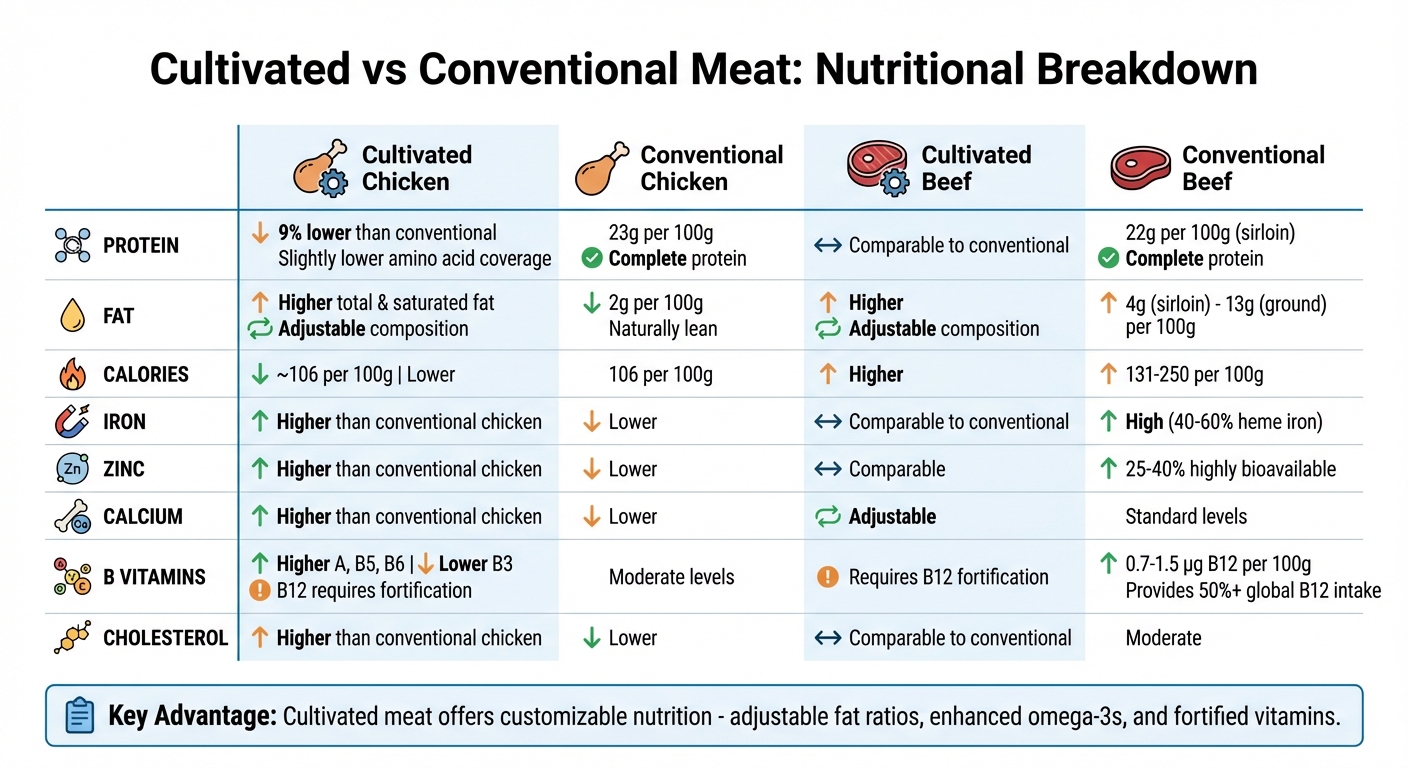
Nutritional Comparison: Cultivated vs Conventional Chicken and Beef
Lab-Grown vs Traditional Meat | Is Lab Grown Meat the Future?
Macronutrients: Protein, Fat, and Calories
After exploring its production process and benefits, let’s now dive into the macronutrient profiles of cultivated chicken and beef.
Protein Content
Both cultivated chicken and beef provide complete proteins, essential for muscle growth and repair. For comparison, a 100g serving of conventional chicken breast contains about 23g of protein, closely matching top sirloin steak's 22g. However, current prototypes of cultivated chicken have around 9% less protein and slightly lower amino acid coverage, as highlighted in a November 2024 study published in the Journal of Food Composition and Analysis by Piotr Rzymski [1]. Despite this, chicken - whether cultivated or conventional - remains a strong choice for those following high-protein, calorie-conscious diets.
Fat and Saturated Fat
When it comes to fat, conventional chicken breast is naturally lean, with just 2g of fat per 100g. This is significantly lower compared to 4g in top sirloin and 13g in ground beef [6]. Early versions of cultivated chicken, however, show higher levels of both total and saturated fats than their conventional counterpart. This difference highlights a key strength of cultivated meat: the ability to customise fat composition. For instance, producers can adjust the balance of saturated and unsaturated fats or even increase omega-3 levels, all while maintaining the flavour profiles that align with UK health recommendations [1][2].
"Where cultivated meat offers unique advantages is in potential optimization: Fat composition control: The ability to influence the ratio of saturated to unsaturated fats." – Cultivated Meat Shop [2]
That said, there are limits to how much fat composition can be altered. The Food Standards Agency points out that saturated fats play a significant role in meat's flavour. Completely replacing them with polyunsaturated fats could impact taste [3]. In the UK, health guidelines suggest keeping saturated fat intake below 10% of total daily energy [4].
Calorie Content
Calorie counts provide another way to compare these meats. Chicken typically comes out ahead for those watching their energy intake. For example, 100g of chicken breast contains about 106 calories, whereas beef cuts range from 131 to 250 calories per 100g [6][7]. Chicken’s higher protein-to-calorie ratio makes it particularly effective for building muscle without consuming excess calories. Cultivated meat, with its consistent nutrient profile, also offers an advantage for precise meal planning [2].
Micronutrients: Vitamins and Minerals
Vitamins and minerals play a crucial role in supporting immune function and maintaining bone health. Below, we take a closer look at the micronutrient profiles of cultivated chicken and beef, comparing them to their conventional counterparts.
Mineral Content: Iron, Zinc, and Calcium
A study published in November 2024 by UPSIDE Foods revealed that serum-free cultivated chicken contains higher levels of calcium, iron, and zinc compared to conventional chicken breast [1]. According to Piotr Rzymski, the study's lead author:
"The CCM [cell-cultured chicken meat] analysed in the present study revealed similarities to the nutritional profile of conventional chicken breast meat, with superior mineral content, particularly regarding Cu, Fe, K, and Zn." [1]
These enhanced mineral levels are achieved by fine-tuning the culture medium used in the production process. Unlike conventional meat, where mineral content is determined by the animal's diet and biology, cultivated meat's mineral profile depends on the nutrients added to the growth medium [3][5]. For example, iron and zinc are not naturally produced by muscle cells; they need to be introduced via the culture medium or supplemented directly [3][5].
Conventional beef, on the other hand, naturally provides more heme iron - a highly bioavailable form that makes up 40–60% of its total iron - compared to chicken [5]. Cultivated beef producers are working to replicate these levels through media optimisation. Achieving similar heme iron concentrations involves specific techniques, such as introducing myoglobin expression [2][3]. Additionally, traditional meat supplies about 25–40% of zinc in a form that is easily absorbed, unlike plant-based sources, which often contain phytates that inhibit absorption [5].
Vitamin Content: B Vitamins and Vitamin A
The vitamin profiles of cultivated chicken and beef also differ significantly. The same 2024 study on UPSIDE Foods' cultivated chicken showed it contains higher levels of vitamins A, B5, and B6, but lower levels of B3, compared to conventional chicken [1].
Vitamin B12 presents a particular challenge for cultivated meat. Animal cells do not produce B12 in vitro, so both cultivated chicken and beef rely on fortification of the growth medium to include this essential nutrient [3][5]. Conventional beef naturally contains between 0.7–1.5 µg of B12 per 100g and contributes over 50% of the global dietary intake of this vitamin [5]. To match these levels, cultivated beef requires significant fortification of its culture medium.
One of the advantages of cultivated meat is the ability to precisely adjust vitamin levels by modifying the growth medium [2][5]. However, this comes with economic challenges, as the culture medium currently accounts for 55–95% of production costs, making any optimisation a balance between nutritional benefits and cost-effectiveness [5].
sbb-itb-c323ed3
Other Nutritional Factors
Amino Acid Profiles
Both cultivated chicken and beef offer complete proteins, but studies suggest they may have 5%–24% lower levels of indispensable amino acids compared to their conventional counterparts [1]. Since cultivated meat is grown from real animal cells, its amino acid profile closely resembles that of traditional meat [2][5].
A study published in November 2024 in the Journal of Food Composition and Analysis analysed UPSIDE Foods' serum-free cultivated chicken. It revealed lower levels of several essential amino acids, including histidine, isoleucine, leucine, lysine, methionine, phenylalanine, threonine, tryptophan, and valine [1].
The amino acid profile of cultivated meat is influenced by factors such as the culture medium, the maturation process, and the type of scaffolds used during production [3]. For instance, collagen-based scaffolds can boost glycine levels, while nutrient deficiencies in the growth medium may lower overall amino acid density [3]. Adjustments to the culture medium can also help tailor the amino acid composition [2][5].
However, muscle cells grown in vitro lack certain conditionally essential compounds like creatine, carnitine, and taurine, which are naturally found in conventional meat [3][5].
Beyond amino acids, other nutritional differences, such as cholesterol levels, also set cultivated meat apart from traditional options.
Cholesterol Levels
Cultivated meat, being derived from real animal cells, naturally contains cholesterol [2]. Interestingly, early findings indicate that some cultivated chicken products may have higher cholesterol levels than conventional chicken. Piotr Rzymski, lead author of the 2024 study on UPSIDE Foods' cultivated chicken, noted:
"Consumption of cell-cultured chicken meat would lead to higher intake of cholesterol and saturated fat." [1]
The same study reported that cultivated chicken prototypes contained elevated levels of total fat, saturated fatty acids, and cholesterol compared to conventional chicken breast [1]. This is a crucial consideration for individuals managing their cholesterol levels for heart health.
While cultivated meat technology has the potential to adjust the balance of saturated and unsaturated fats, it's worth noting that saturated fats contribute significantly to meat's flavour. Reducing them too much could impact taste [2][3][5].
For those weighing cultivated chicken and beef based on cholesterol content, it's important to recognise that current prototypes may not yet offer the heart-health benefits often associated with this emerging technology. The nutritional profile of cultivated meat is still highly dependent on variables like production methods, the composition of the culture medium, and the specific maturation techniques employed [3][5].
Summary
Cultivated chicken and beef deliver complete proteins that are identical to those found in conventional meat [2]. When comparing the two, cultivated beef tends to have higher levels of fat, calories, heme iron, and zinc, while cultivated chicken is a leaner option with increased amounts of B vitamins like B5 and B6 [2][1]. These distinctions open the door to further refining their nutritional profiles.
Early versions of cultivated chicken have demonstrated higher levels of minerals such as copper, iron, potassium, and zinc [1]. However, some prototypes have shown slightly reduced protein content and higher saturated fat levels [1]. These differences largely depend on production methods, which are continuously being improved.
One of the most promising aspects of cultivated meat is its ability to be nutritionally tailored. Producers can adjust fat content, increase omega-3 fatty acids, and fortify the meat with specific vitamins or minerals during production [2][3]. This adaptability means future products could be designed to meet particular dietary requirements while still delivering the familiar taste and texture of traditional meat. This makes cultivated meat a compelling option for those prioritising health and nutrition.
For in-depth guides, product previews, and updates on the latest research, visit Cultivated Meat Shop. You can also join the waitlist to stay informed about when these products will become available in the UK.
FAQs
How does the fat content of cultivated chicken compare to traditional chicken?
Cultivated chicken generally contains more fat compared to traditional chicken. Research indicates it has a higher amount of total fat, including saturated fats, as well as elevated cholesterol levels when compared to conventional chicken.
These differences in fat content could play a role in your dietary decisions, especially if you're focusing on specific nutritional goals or addressing particular health concerns.
Does cultivated chicken have more vitamins and minerals than conventional chicken?
Early findings indicate that cultivated chicken might contain higher amounts of certain vitamins and minerals when compared to its conventional counterpart. These include vitamins B5, B6, and A, along with minerals such as calcium, iron, potassium, selenium, and zinc. This could make it a more nutrient-dense option overall.
On the flip side, research suggests that cultivated chicken may have slightly lower levels of essential amino acids and protein. Scientists are working to fine-tune its nutritional composition to ensure it aligns with dietary requirements. While these developments are encouraging, more research is needed to fully understand how it stacks up against traditional chicken in terms of health benefits.
Can cultivated meat be customised for specific dietary needs?
Cultivated meat offers the possibility to be adjusted to fit specific dietary preferences and health needs. Because it’s developed from animal cells in a controlled setting, producers can tweak its nutritional makeup. For example, they can lower the fat content, boost protein levels, or incorporate particular micronutrients to match different dietary goals.
This ability to personalise makes cultivated meat an appealing choice for people aiming for diets that are low in fat, high in protein, or packed with essential nutrients. It provides a way to enjoy real meat while aligning with individual health priorities.